Why We Overthink
Why do some conversations replay in our minds long after they’ve ended? Discover why overthinking is often less about having too many thoughts and more about the mind searching for safety in the face of uncertainty.





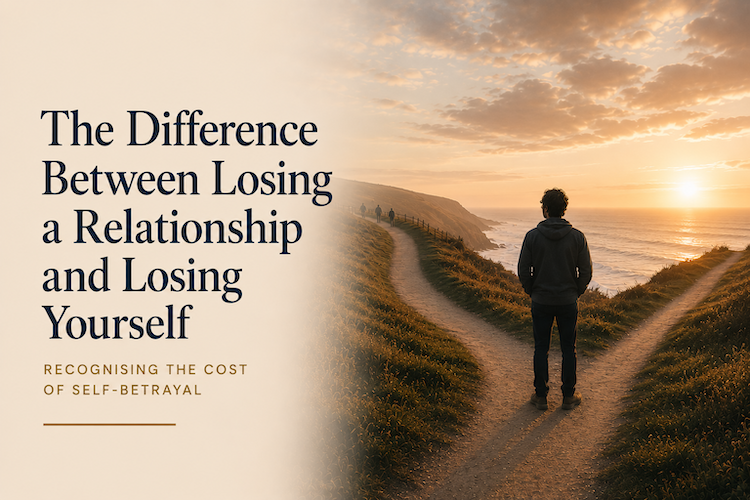
Relationships ask things of us.
They ask for compromise, patience, forgiveness and understanding. No healthy relationship exists without these qualities. At times, we all set aside our own preferences for the sake of someone we love.
That is part of intimacy.
But there is an important line that often goes unnoticed. A relationship can ask us to compromise without asking us to abandon ourselves.
When that line is crossed, something fundamental begins to change.
Most people think the hardest part of leaving a relationship is losing the other person.
Sometimes it is. But there is another kind of loss that often hurts far more: the gradual loss of yourself.
It rarely happens overnight. More often, it unfolds quietly.
You begin doubting your own judgement. You explain away behaviour that doesn’t sit right. You minimise your feelings because they seem inconvenient, and you stop raising concerns because doing so leads to conflict, withdrawal or criticism.
Little by little, your attention shifts away from one question:
“What am I genuinely experiencing?”
Towards another:
“What do I need to do to keep this relationship working?”
The relationship becomes the priority, and your own reality slowly becomes negotiable.
Healthy relationships encourage us to grow. Sometimes they challenge us, reveal uncomfortable truths about ourselves or require humility.
But growth is not the same as self-denial.
Growth moves us closer to who we are.
Self-denial moves us further away.
If maintaining a relationship consistently requires you to dismiss your own perceptions, ignore your emotional reality or repeatedly violate your own values, the problem is no longer simply the relationship.
The relationship has begun to reshape your relationship with yourself.
People often ask themselves whether they should stay or leave. They weigh up history, children, finances, loyalty and hope.
These are all important considerations.
But there is another question that can sometimes bring surprising clarity.
Who am I becoming if I stay?
Not, Who do I wish the other person would become?
Not, Who might they become?
But, Who am I becoming?
Am I becoming more open?
More secure?
More authentic?
Or am I becoming increasingly anxious, guarded, doubtful or disconnected from myself?
Sometimes the answer to that question tells us more than months of analysing the relationship itself.
Leaving a relationship often involves profound grief. We don’t simply lose a person. We lose routines, shared dreams, family traditions and the future we imagined.
It is natural to mourn those things.
But there are times when grief becomes the healthier alternative. Not because leaving is easy, but because staying requires something even more costly.
Self-betrayal rarely feels dramatic. It usually looks like repeatedly overriding your own instincts until you no longer trust them.
The tragedy is that we may preserve the relationship while quietly losing the person who was living inside it.
Boundaries are often misunderstood. They are sometimes seen as punishment, rejection or an attempt to control someone else’s behaviour.
In reality, healthy boundaries usually protect something much closer to home.
They protect our ability to remain psychologically intact.
They protect our capacity to trust our own experience.
They protect the relationship we have with ourselves.
Sometimes people assume that choosing distance means someone is unwilling to forgive.
Often the opposite is true.
Sometimes distance is simply what becomes necessary when closeness repeatedly requires us to disconnect from ourselves.
After a relationship ends, it is natural to ask:
“What have I lost?”
But healing sometimes begins with a different question:
“What have I protected?”
If the answer is your integrity…
Your values…
Your ability to recognise yourself…
…then perhaps the ending was not simply a loss.
Perhaps it was also an act of preservation.
Because there are many painful things we may lose throughout life, and a relationship may be one of them.
But if losing that relationship allows us to keep ourselves, we may discover that we have protected the one relationship that quietly shapes every other.
The relationship we have with ourselves.
Why do some conversations replay in our minds long after they’ve ended? Discover why overthinking is often less about having too many thoughts and more about the mind searching for safety in the face of uncertainty.
Psychological safety is the foundation of every healthy relationship. Discover why your nervous system’s sense of safety matters more than many people realise, and the conditions that allow trust, openness and genuine connection to grow.
After betrayal, many people become preoccupied with the timeline—searching for the moment everything changed. This article explores why that search isn’t simply about the past, but the mind’s attempt to rebuild a coherent understanding of reality.