01
The injury beyond betrayal
Explore why the psychological consequences of betrayal can continue long after the original event, particularly when the harm remains unacknowledged.

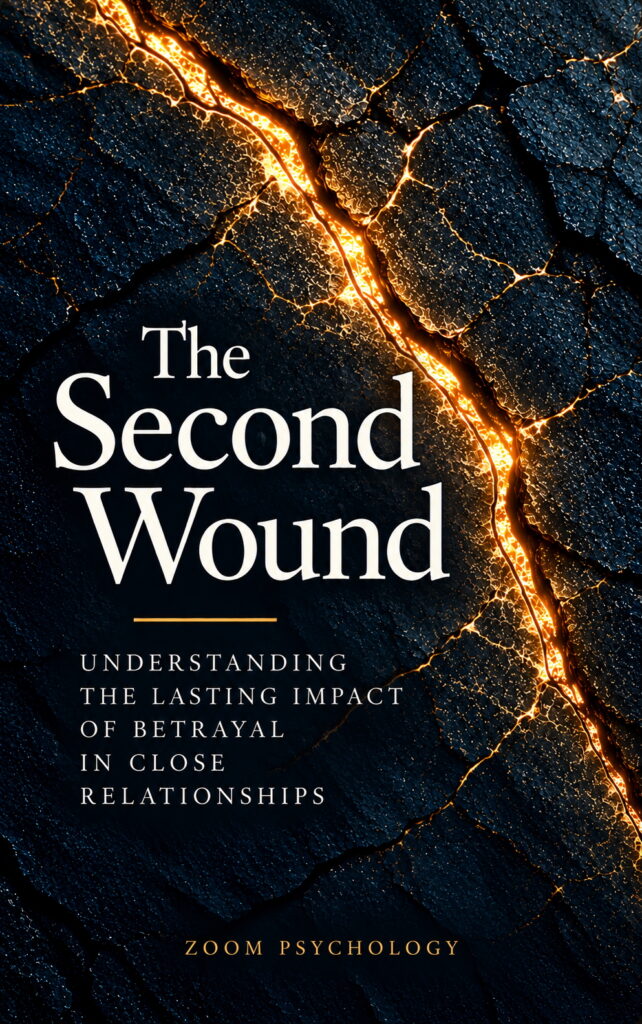
Understanding the Lasting Impact of Betrayal in Close Relationships
Betrayal can leave injuries that extend far beyond the original event. This book explores the psychological consequences of betrayal in close relationships, the struggle for acknowledgment and accountability, and the difficult process of finding a way forward when those responsible do not acknowledge the harm they have caused.
12 chapters · EPUB ebook · A$14.95
Inside the pages
Explore two complete chapters from The Second Wound. Read here, at your own pace.
Select a chapter title to open or close it.
For years, Daniel remembered a weekend on the coast without having to think about it. They had eaten dinner late and walked back to their accommodation in the cold. His partner had laughed at something he said, then reached for his hand. It remained one of his favourite memories of their relationship. Nothing about the evening had felt false to him.
Much later, after discovering that she had concealed another relationship, Daniel learned that the deception had already been taking place during that trip. He found himself returning to the same memory with a question he could not easily answer. Had they been happy together, or had he been happy alone in an arrangement he did not understand?
The question offered no satisfactory answer. His happiness was not in doubt; he could still recall the warmth of that evening. Yet he could no longer assume that he and his partner had shared the same understanding of their lives. His memory had not changed, but the information available to interpret it had.
Friends encouraged him to focus on what was ahead. He understood their concern, but he was still trying to work out what had happened behind him. He reviewed ordinary conversations, wondered what certain silences had meant and questioned whether his confidence in the relationship had been a failure of judgment. He did not want to become suspicious of everyone. He wanted to understand how he could have felt so secure while something important remained hidden.
Daniel is fictional. His experience illustrates one of betrayal’s less visible consequences: a discovery in the present can disturb the meaning of experiences that seemed settled in the past. Much of that disturbance begins with what trust had allowed him to take for granted.
Trust is more than confidence in another person’s honesty or reliability. In a close relationship, trust also changes the amount of attention we need to devote to uncertainty. We do not ask for evidence of every ordinary explanation, examine every delay or continually test whether an affectionate gesture is sincere. We take much of what happens between us as sufficiently dependable to get on with our lives.
Such reliance is not necessarily naive. Human beings routinely make decisions with incomplete information. We rely on patterns, prior experience and the apparent consistency of what people say and do. In a relationship that has become familiar, these expectations acquire practical importance. They allow partners to share money, homes, responsibilities, vulnerabilities and plans without renegotiating the foundations of the relationship every morning.
The benefit is partly attentional. Confidence in a partner leaves more energy for work, children, friendships, rest and the future. We are spared the burden of continually checking whether the basic account of our shared life is accurate. We remain capable of noticing concerns without treating every ordinary uncertainty as a warning.
After discovering significant deception, that economy of attention can collapse. A statement that once settled a concern may now prompt further questions. An unexplained absence that previously seemed unremarkable may be reconsidered. A person may begin searching old messages or reconstructing timelines, not simply to gather facts but to establish which assumptions can still be relied upon.
A painful reversal can follow: the person begins to treat their former trust as evidence that they were foolish, inattentive or weak. They might tell themselves that they should have known. Yet the absence of constant investigation was often an expression of the relationship operating as a trusted relationship is supposed to operate. Not monitoring a partner is not, by itself, a failure of judgment. It may reflect a reasonable reliance on commitments that the other person was expected to honour.
Betrayal can therefore undermine confidence in the partner and, more quietly, confidence in one’s own judgment. A person who once made decisions comfortably may begin to feel that every judgment requires additional proof. The original deception becomes the basis for a wider doubt: if I was wrong about something so important, what else might I be wrong about?
Deception, however, is not proof of poor judgment. It may establish that another person possessed information they chose not to share. A trusting person’s limited knowledge is not equivalent to an observer’s full knowledge after the event. The distinction between those two vantage points becomes crucial when people start blaming themselves for what they did not know.
The significance of betrayal depends partly on the relationship in which it occurs. An acquaintance who lies may disappoint us. An intimate partner who lies about something central to the relationship may unsettle a much larger part of our emotional life, because the partner is woven into how we regulate distress, understand ourselves and anticipate the future.
Attachment theory offers one explanation. Adult partners can become important sources of comfort and security. Their availability may help us tolerate uncertainty elsewhere in life. The person we turn towards when we feel threatened is not merely someone whose opinion we value; their presence may itself be reassuring. This is one reason intimate betrayal can create a difficult contradiction: the person associated with comfort is now also associated with harm.
Johnson, Makinen and Millikin (2001) described attachment injuries in the context of couples therapy, particularly moments when a partner fails to respond with expected care during a critical need. Their clinical formulation is not interchangeable with every instance of infidelity or deception. 1 Nevertheless, it highlights a useful principle: the psychological meaning of an event depends not only on the behaviour but on the care and protection the relationship had led someone to expect.
Someone may be certain that separation is necessary and still long for the former partner to respond with concern. The wish for an explanation can survive the wish to restore the relationship. To an observer, this can seem inconsistent. If the relationship is over, why does that person’s response still matter?
One answer is that attachment expectations are learned through repeated experiences; they do not disappear as quickly as a deliberate decision can be made. A person may intellectually reject further intimacy while emotionally continuing to orient towards the person who once provided reassurance. The longing for understanding does not necessarily indicate a wish to reconcile. Nor does it mean the person approves of what occurred. Attachment and endorsement are different psychological processes.
Advice to ‘stop caring what they think’ overlooks this history. It treats an established emotional relationship as though it were a preference that could be cancelled on request. Over time, emotional priorities can change, especially with distance, reliable support and new experiences. But knowing that a relationship should end is not the same as immediately becoming indifferent to the person within it.
Attachment cannot explain every response. Some people feel relief after betrayal, particularly when the relationship had long felt unsafe. Others are more distressed by practical losses, humiliation, uncertainty or the disruption of their family life than by a continued wish for closeness. Relationship history, earlier experiences, personal resources and social circumstances all shape the response. A useful theory illuminates part of the experience; it should not be made to explain everyone.
After a significant discovery, people sometimes describe a heightened sensitivity to details that previously escaped their attention. They may notice changes in tone, scan for inconsistencies or feel uneasy around reminders of the relationship. Sleep and concentration may suffer. Ordinary decisions can become harder because the mind repeatedly returns to unanswered questions.
In a qualitative study of romantic partner betrayal, Lonergan and colleagues (2021) described accounts of substantial distress and difficulty making sense of the experience. The study involved a small, selected group of participants, offering insight into possible experiences rather than an estimate of how common those reactions are. It is also important not to confuse intense distress with a particular diagnosis. Betrayal may be experienced as traumatic in the everyday sense without meeting the diagnostic requirements for post-traumatic stress disorder. 2
Uncertainty and prediction may help explain this preoccupation. We use what we know about the past to anticipate what is likely to happen next. When an important assumption proves unreliable, the mind may increase its search for information. It is attempting to update a model of the world that has produced a painful surprise.
This search can initially be useful. Clarifying what happened may inform decisions about separation, health, finances or future contact. It may also help the person distinguish confirmed events from fears and speculation. But searching can change character when it repeatedly returns to questions for which no dependable evidence is available. Each new possibility generates another possibility; a reassuring answer lasts only until the next doubt appears.
This is one route by which an understandable effort to make sense of betrayal may become rumination. Rumination is not simply thinking a great deal. It is a repetitive style of thought that can feel productive while yielding little new understanding or action. The person may keep approaching the same question because it remains emotionally urgent, even when another hour of analysis is unlikely to resolve it. 3
The distinction is not whether the question matters. It may matter enormously. The distinction is whether the present form of thinking is helping the person learn, decide or act. Sometimes it is. Sometimes the mind is asking an unanswerable question with increasing intensity, hoping that effort alone will create certainty.
We should also be careful about what can be inferred from this behaviour. Repeated checking is not proof that someone has an anxiety disorder, nor does it mean they are choosing to remain distressed. Equally, understandable vigilance does not make unlimited monitoring, interrogation or intrusion appropriate. Psychological explanation should help us recognise both the origins of a response and the point at which that response may begin to cause additional difficulties.
A further difficulty arises when new information appears inconsistent with the character we believed another person possessed. The problem is not always that every memory now seems false. It may be that the memories are true, but no longer sufficient to support the conclusions we once drew from them.
Daniel’s weekend illustrates this distinction. His happiness was real. The conversation, the walk and the feeling of closeness were experiences he genuinely had. What changed was his understanding of the wider circumstances. He had interpreted the weekend as evidence of a relationship in which both people were acting within the same commitments. The later discovery challenged that interpretation without erasing the evening itself.
The task is harder than assigning the former partner a single moral identity. People can behave with warmth in one context and selfishness in another. They may show genuine affection while concealing decisions that cause serious harm. Recognising this possibility does not excuse deception. It prevents the injured person from being forced into an equally implausible choice between declaring the entire relationship a lie and treating the betrayal as insignificant.
One way of making sense of relationships is to build coherent accounts of people. We make judgments about character from patterns of behaviour, then use those judgments to interpret new events. When a major contradiction appears, we may respond by trying to fit every past event into one explanatory story. Some people reinterpret all earlier affection as manipulation. Others minimise the betrayal because they cannot reconcile it with years of apparent care. Neither conclusion is always warranted by the available evidence.
An account faithful to the evidence may have to hold competing truths. A relationship may have contained genuine affection and serious deception. A partner may have contributed meaningfully to someone’s life and also acted in ways that undermined it. An injured person may cherish parts of the past while deciding that the relationship cannot continue. This does not produce a neat story, but psychological accuracy is not always neat.
Reconstructing the past carries another risk. Knowledge acquired later can make earlier warning signs seem more obvious than they actually were. Once we know the outcome, we may struggle to remember how uncertain the situation was at the time. We begin to judge earlier decisions using evidence that was unavailable when those decisions were made. This retrospective distortion can intensify self-blame: I should have noticed; I should have asked; I should have understood.
A fairer inquiry asks what a reasonable person could have concluded from the information available then, rather than from what seems obvious now. That does not mean ignoring concerns that were present. It means evaluating the past without pretending we possessed knowledge we only acquired afterwards.
Betrayal can also disrupt expectations that extend well beyond the relationship itself. People organise their lives around anticipated continuities: a shared home, growing older together, raising children, caring for relatives, making financial decisions or simply knowing who will be there at the end of an ordinary day. These expectations become part of the structure of daily life long before we consciously describe them as hopes.
When a relationship ends, the loss can therefore concern a future that never occurred. Someone may grieve the family occasions they imagined, the familiar rituals that will change and the sense of continuity they expected their life to have. This is not evidence that the future was guaranteed or that the relationship would necessarily have remained satisfying. It is recognition that people invest emotionally in anticipated lives, and that losing those expectations can be painful.
The practical consequences can make the psychological work more demanding. Changes in housing, finances or parenting arrangements may require immediate decisions while the person is still trying to understand the betrayal. Shared responsibilities can also mean that contact continues after intimacy has ended. A person may have to negotiate ordinary matters with someone whose reliability they now question. The emotional and practical tasks do not always proceed at the same pace.
Yet the experience is not uniform. Some people feel liberated by separation; some discover that their friendships and sense of identity become stronger; some experience profound grief alongside relief. A clinically responsible account should make room for mixed feelings and change over time. It should also resist the idea that an injured person’s continuing sadness proves that they have failed to accept reality. They may have accepted the separation while still mourning what it changed.
Understanding the injury requires separating problems that often arrive together.
The first problem concerns evidence: what is known, what remains uncertain and which questions can realistically be answered. The second concerns meaning: how the events affect trust, identity, memory and expectations. The third concerns action: what decisions are needed now, regardless of whether the first two problems have been fully resolved.
These questions need not be answered in sequence. A person can decide to separate while remaining unsure about the precise timeline of events. They can acknowledge that a relationship included meaningful experiences while deciding that renewed contact would be harmful. They can recognise that another person’s explanation might have helped while choosing not to organise their future around obtaining it.
The aim is neither to erase the importance of the betrayal nor to make it the permanent organising principle of the person’s life. It is to recover the capacity to make judgments under ordinary uncertainty. Complete certainty about another person’s inner life was never available, even before the betrayal. What may gradually become possible is a more grounded confidence in one’s ability to notice evidence, tolerate what cannot be known and make choices consistent with one’s values.
Trust had allowed Daniel to inhabit his relationship without continually checking its foundations. The discovery unsettled his memories as well as his confidence in himself. Still, his question remains. If the weekend was genuinely happy for him, what does it mean to learn that the circumstances surrounding it were different from what he believed? And what happens when a discovery changes the apparent meaning of not one evening, but years of shared history?
The questions reach beyond a single memory. They concern the conditions under which a person understood an entire shared life.
Leah could describe the end of her relationship without becoming overwhelmed. She had found a new home, made decisions about her finances and grown accustomed to a life that no longer included her former partner. Yet one exchange remained strangely unfinished. When a friend asked what she still wanted from him, Leah surprised herself by answering, “I want him to acknowledge that it mattered.” She was not asking him to come back. She was asking for a response to something that had already happened.
What she still wanted was a conversation in which her former partner could say, without qualification, that he recognised the consequences of the deception and his part in them. She did not need him to agree with every memory or accept every interpretation. She wanted him to recognise that she had lived through something consequential, and that his choices had contributed to it.
When she tried to explain, the conversation usually shifted. He said they had both been unhappy. He reminded her of arguments they had years earlier. Sometimes he insisted that she was making things worse by returning to the subject. Leah would leave the exchange with more to say than when she entered it. The original event remained painful, but she was now also struggling with the apparent impossibility of having its significance recognised.
Leah is fictional. Her experience introduces the book’s central concern: the injury itself and the response it receives may become separate sources of suffering. The first may involve a breach of trust. The second may involve discovering that the person whose conduct mattered most is unwilling, unable or not yet prepared to engage with its impact. When that happens, an attempt to make sense of the past can become an ongoing relational struggle in the present.
Acknowledgment sounds simple until two people discover they mean different things by it. Someone might acknowledge that an event occurred, recognise that another person was hurt, accept that their own behaviour contributed to the harm, or offer to change what happens next. These responses overlap, but they are not identical.
A person may accept the factual account while remaining indifferent to its emotional consequences. Another may express sympathy for the distress while disputing important details. Someone may apologise sincerely yet remain unable to answer every question. And a person may recognise harm without wishing to resume a relationship. Treating all of these as a single requirement can leave conversations confused before they begin.
It helps to distinguish four layers. Factual acknowledgment concerns what occurred, to the extent it can reasonably be established. Impact acknowledgment concerns what another person experienced and why that experience matters. Responsibility concerns the part one’s own conduct played in creating or worsening the situation. Repair concerns what, if anything, can be done now to address consequences or reduce the likelihood of further harm.
These layers seldom arrive neatly together, and genuine disagreement or uncertainty may constrain what either person can say. Recognising someone’s distress does not require endorsing every conclusion they draw about motives. Conversely, disagreement about a detail does not require dismissing the distress itself. A conversation can preserve both propositions: I remember that differently and I understand that what happened was profoundly painful for you.
An injured person may be accused of demanding agreement when they are asking only for recognition. At other times, a person may sincerely seek acknowledgment but come to expect a precise statement of culpability that the other party will not provide. Neither situation can be understood adequately by treating the word as self-explanatory.
The four layers also explain why a conversation can seem circular even when both people believe they have answered the question. Suppose a former partner says, I know you were hurt. That may satisfy the request for impact recognition while leaving a factual question unresolved: Do you accept that you concealed the relationship while we were still together? Conversely, a precise timeline may answer the factual question without communicating care. The person seeking acknowledgment can therefore receive an answer and still experience the conversation as incomplete, because it answered a different question.
A further complication is that acknowledgment is sometimes offered in a form that immediately retracts its emotional meaning. I am sorry you were hurt, but we were both unhappy may contain an expression of regret, yet the qualification can redirect attention from the particular conduct to the general state of the relationship. Context can be relevant and truthful; the problem is not the presence of context itself. It is whether context is being used to illuminate responsibility or to replace it. A relationship can have been unhappy, and a decision within it can still deserve separate examination.
Rather than searching for a perfect script, it may help to ask: what, specifically, remains unrecognised? Is it the event, its consequences, a person’s contribution, or the possibility of repair? These are distinct needs, and no single sentence will necessarily satisfy all of them. Making the distinction can clarify the conversation even when it cannot change the outcome.
There is another version of this struggle that does not begin with a failure to communicate. The injured person may believe that the person responsible already appreciates the seriousness of what occurred. The missing response is not an explanation of why the conduct was painful, but an acknowledgment of the conduct and its consequences. Repeating the account can then feel less like an attempt to inform someone than a request that they stop treating an understood injury as though it requires no answer.
Understanding, acknowledgment and accountability are separate matters. A person may know that another has suffered without openly recognising their own contribution. They may admit a fact while resisting its moral implications. They may express concern yet decline to correct a misleading account or change conduct that continues to cause harm. The injured person can therefore be asking for responsibility rather than comprehension, even when the conversation superficially sounds like another attempt to explain.
No observer can establish another person’s private awareness simply from their occupation, intelligence or familiarity with the circumstances. Apparent indifference may have different explanations, including defensiveness, disagreement, avoidance or a genuinely different understanding. The distinction still matters: the injured person need not assume that better wording will resolve a refusal of accountability. The question may be what the other person is willing to recognise or do, not what they are capable of understanding.
Our understanding of important experiences is partly social. We do not build a sense of reality solely by consulting private memory; we also interpret events through conversation, relationships and the responses of people whose judgment matters to us. When we describe something painful and another person responds with attention, the response may help us organise what happened. It tells us that the experience is intelligible to someone beyond ourselves.
Other people do not determine what is true by agreeing about it. Other people can be mistaken, uninformed or motivated to preserve their own comfort. Yet the social recognition of suffering can still have psychological importance. Research on social acknowledgment after traumatic events examines how survivors perceive recognition or disapproval from their social environment. That literature does not establish that every relational betrayal is a traumatic event, but it offers a relevant way to understand why the reactions of others may influence adjustment. 1
A particular difficulty arises when the person from whom recognition is sought was also involved in causing the injury. The injured person may be asking that person to perform two psychologically demanding tasks: look directly at painful consequences and recognise their own connection to them. A response that might be easier for a supportive friend may be much harder for someone who experiences acknowledgment as a threat to their self-image, their preferred account of the relationship or their current life.
The asymmetry can be stark. For the injured person, acknowledgment may seem like a modest request for reality to be recognised. For the other person, it may feel like an invitation to accept a moral judgment with consequences they fear. This difference in perceived stakes can help explain why apparently simple conversations become prolonged disputes. It does not establish which account is correct, or excuse deception and dismissal. It clarifies why the participants may believe they are discussing different questions.
There is an apparent paradox in asking the person associated with an injury to confirm its significance. Their response may matter enormously, but they may also be the least reliable person from whom to seek an impartial account. This does not make the request irrational. It reflects the relational history: their view once carried special weight because the relationship involved mutual knowledge, shared commitments and expectations of care.
Still, another person’s response has two different kinds of authority. They may possess information about their own conduct, decisions and intentions that nobody else can supply. They do not possess exclusive authority over the injured person’s emotional experience. The first kind of information can sometimes help establish what occurred. The second cannot determine whether distress is legitimate merely by being granted or withheld.
The stakes rise when acknowledgment becomes entangled with self-trust. Someone may begin to feel that if the other person will not recognise the harm, perhaps their own account is somehow less credible. But a refusal to acknowledge is evidence about the conversation and its limits, not a conclusive verdict on the original experience. Nor is the injured person’s certainty automatically proof that every inference is correct. The work is to distinguish what can be established, what is interpreted and what remains unknown.
A person who feels misunderstood often tries to become clearer. They provide context, correct an omission, reconstruct a sequence of events or choose gentler language. In ordinary communication, these efforts can be productive. When the listener is receptive, explanation creates opportunities for mutual understanding.
But explanation can also become a repeating task with no clear endpoint. Each attempt produces a new objection. The injured person responds to that objection, only to discover that the conversation has moved elsewhere. What began as an effort to explain the impact of an event becomes an effort to secure the conditions under which the event may even be discussed.
This pattern has a cognitive dimension. An unresolved interpersonal exchange may remain mentally active because the person continues to anticipate a different outcome. They think of a better example in the shower, rewrite a message at midnight or imagine the sentence that would finally make their meaning unmistakable. The mind treats the problem as one that might be solved through improved communication. Sometimes that is true. Sometimes the obstacle is not the quality of the explanation but the other person’s willingness or capacity to engage.
That possibility hurts because effort, precision and sincerity may still be insufficient. A person can communicate an experience accurately and still not receive the response they hope for. This is different from concluding that the experience is inaccurate. It is a recognition of the limits of interpersonal influence.
There is also a cost to repeatedly returning to a conversation that leaves a person distressed. The immediate disappointment may be followed by renewed analysis, rehearsed arguments and difficulty attending to other areas of life. Yet the person may feel reluctant to stop because stopping appears to concede that the injury was insignificant. The pursuit of acknowledgment can become entangled with the preservation of one’s own account of what happened.
Repeated explanation can acquire a compelling logic. Each unsuccessful exchange seems to reveal a flaw in the previous attempt: perhaps the message was too emotional, too long, too blunt or insufficiently precise. The next attempt promises to correct that flaw. This can keep a person engaged even when the broader pattern offers little reason to expect a different result.
The difficulty is not that communication skills are irrelevant. They matter greatly when two people are willing to listen. The difficulty is that communication is a joint activity. One person’s clarity cannot substitute for another person’s participation. A better explanation can improve the opportunity for understanding; it cannot manufacture the willingness to understand.
The distinction can also prevent an unfair conclusion about the injured person. Continuing to ask is not necessarily evidence of obsession or weakness. It may reflect a reasonable expectation that important harm should be addressed. Yet a reasonable request can become costly when repeated in circumstances where the conditions for a meaningful response are absent. At that point, the question may change from How can I explain this more effectively? to What does continuing this exchange now cost, and what is it realistically likely to provide?
A further distinction is necessary. Being heard is not the same as being vindicated. A person can listen carefully and still disagree. An apology can be meaningful without resolving every contested fact. A listener can recognise genuine suffering without confirming every attribution of intention.
These distinctions protect the integrity of acknowledgment. If recognition requires total agreement, it becomes difficult to offer honestly. If disagreement is treated as proof of indifference, even a potentially constructive conversation may collapse. On the other hand, repeated appeals to uncertainty can also become a way of avoiding matters that are clear enough to address. A person need not know everything about another’s experience to acknowledge what is plainly within their knowledge.
The question is not whether all parties must adopt a single narrative. It is whether they can engage with the impact of their actions without requiring the injured person to abandon their experience as the price of being treated respectfully.
Consider two responses to the same disclosure. One says, I don’t agree with every part of how you remember that period, but I can see that my decision left you without information you needed and that it hurt you. The other says, We remember things differently, so there is no point discussing your hurt. Both acknowledge disagreement. Only the first leaves room for the other person’s suffering to matter.
A healthy account of acknowledgment must also make space for situations in which the injured person’s interpretation is mistaken, incomplete or influenced by intense distress. Compassion does not require accepting an unsupported accusation. It does require taking the person seriously enough to respond to the actual concern rather than dismissing them for having it.
When people are confronted with harm they may have caused, they can experience shame, guilt, fear, anger or a threat to their sense of being a decent person. These reactions are not identical. Guilt can direct attention towards a particular action and its consequences. Shame may feel more global, implicating the self rather than the behaviour. Either can lead to reflection; either can also contribute to avoidance or defensiveness depending on the person and circumstances.
People may minimise conduct, emphasise the context that made it understandable to them or focus on the injured person’s reaction. They may genuinely remember events differently. They may fear that acknowledging one part of an account will be taken as agreement with everything else. Sometimes the refusal to engage reflects indifference; sometimes it reflects emotional limitations, competing commitments or an effort to avoid conflict. The same outward behaviour can have different causes.
This uncertainty matters. An injured person can reasonably describe the impact of persistent nonrecognition without claiming access to another person’s inner motives. It may be accurate to say, My experience has not been acknowledged, while remaining uncertain whether the reason is unwillingness, inability, disagreement or something else.
Chapter 6 will examine self-protective explanations and moral self-concept in more detail. Here, the relevant point is narrower: acknowledgment can be psychologically costly for the person being asked to provide it, even when it would be deeply meaningful to the person seeking it. The cost may help explain resistance, but it does not determine whether that resistance is justified.
Two people may use the same sentence and communicate very different things. I cannot talk about this now can be a temporary limit offered with care and a clear intention to return to the subject. It can also become a repeated way of ensuring that the subject is never addressed. What matters is not only the wording but the pattern, context, follow-through and practical consequences.
This is one reason the second wound should not be reduced to the absence of a particular phrase such as I’m sorry. A perfunctory apology may leave someone feeling unheard, while a careful conversation without an explicit apology may offer meaningful recognition. The psychologically relevant question is whether the person encounters a sustained willingness to take the injury seriously, not whether a verbal formula has been performed.
We should also distinguish a limit from a dismissal. People may legitimately decline abusive exchanges, repeated interrogations or conversations they cannot manage safely. Setting such a limit is not, by itself, evidence that they deny another person’s suffering. But a boundary on how a conversation occurs does not logically settle whether the underlying harm deserves acknowledgment. Both propositions can be true.
Not every disappointing conversation produces a second wound. People sometimes disagree in good faith, require time to reflect or fail to respond well because they are overwhelmed. The concept becomes more useful when we consider the pattern and meaning of what follows an original injury.
Imagine that someone discovers serious deception in an intimate relationship. The discovery unsettles their trust and their understanding of the past. They then attempt to discuss its consequences with the person involved. If those attempts are consistently met with ridicule, dismissal, blame shifting or demands that the subject never be raised, the response may add a new experience of relational insecurity.
The first injury concerns what was concealed or done. The later experience concerns the apparent absence of recognition and care when the consequences become visible. This distinction does not require a clinical diagnosis, and it should not be treated as a fixed sequence that occurs in every case. It is a way of identifying an additional source of distress that can otherwise disappear inside the general phrase difficulty moving on.
The second wound may be especially painful because it challenges an expectation that survived the first. A person may have lost trust in their partner’s fidelity yet still expect that partner to care about the suffering caused. When even that expectation appears misplaced, the injury can extend from I did not know what was happening to I did not know how little my pain would matter to you. The latter conclusion may or may not accurately describe the other person’s inner experience, but it can describe the injured person’s lived interpretation of repeated responses.
This is one reason the distinction between intention and impact is indispensable. A dismissive response can cause additional distress even when the person offering it does not intend to injure. Equally, the injured person’s interpretation of that response should remain open to examination rather than automatically becoming an established fact about the other’s character.
The need for recognition does not end with the person responsible for the original harm. Friends, relatives and professionals can influence whether someone feels able to make sense of what happened. A friend who listens without rushing to judgment may help create room for complexity. A relative who insists that the subject is inconvenient may unintentionally communicate that the relationship’s outward stability matters more than the injured person’s experience.
There are limits here too. Friends and family may not know the full history. They may have responsibilities to multiple people, or may choose not to adjudicate disputed events. Such limits do not necessarily amount to betrayal. Yet refusing to determine blame is different from refusing to recognise that someone is suffering. It is possible to remain uncertain about the facts while still responding with care.
The social consequences of invalidation will be explored in Chapter 8. For now, it is enough to notice that acknowledgment is not solely a private exchange between two people. It can affect whether a person feels understood within the wider relationships on which they rely.
Research on social acknowledgment and on responses to disclosures of interpersonal harm offers a useful foundation for this chapter. It suggests that how people are received by others can be associated with psychological adjustment. It does not establish a single causal pathway from a former partner’s refusal to apologise to a particular symptom, nor does it demonstrate that all people who seek acknowledgment have accurately reconstructed every disputed event.
The phrase second wound is therefore best understood as a proposed interpretive framework: it directs attention to an additional source of distress that can follow an original relational injury. It is not a diagnosis, a measurement scale or a claim that the literature has already isolated one universal syndrome. Its usefulness depends on whether it helps readers ask more precise questions about their experiences while leaving room for complexity and individual variation.
That distinction also protects the book from a seductive but unhelpful certainty. A person’s suffering deserves serious attention; it does not grant infallibility about another person’s motives. A person’s disagreement deserves examination; it does not erase the consequences of conduct they can reasonably acknowledge.
An acknowledgment may be important even when the person being asked refuses to provide it. That uncomfortable fact belongs within the present account of the struggle, because it explains why another attempt can feel both necessary and futile. The injured person may know exactly what they want recognised and still have no reliable means of obtaining it. Clarity about the request improves communication; it does not confer influence over the answer.
There may be practical reasons to make a further request, especially when facts remain consequential or new information emerges. There may also be reasons to stop an exchange that has repeatedly produced evasion or hostility. Neither decision establishes that the injury was insignificant. What matters here is the structure of the predicament: the person asking for recognition can explain, invite and listen, but cannot supply the other person’s willingness. The later question of how to live with that limit is different, and deserves treatment in its own right.
When people ask for acknowledgment, they are sometimes asking for more than an apology or a factual concession. They may be asking whether the relationship they believed existed contained enough care for their suffering to matter, even after the relationship changed. They may be asking whether their memories, decisions and losses are visible to anyone besides themselves.
No single conversation can settle every part of those questions. Another person’s response may offer meaningful recognition, but it cannot by itself restore every lost assumption or determine the entire meaning of the past. Equally, the absence of that response does not make the injured person’s experience unreal.
The struggle for acknowledgment becomes easier to understand when we see it not simply as a demand to be agreed with, but as an attempt to recover some form of shared reality after a relationship has ceased to provide it. Sometimes that attempt is met with compassion. Sometimes it encounters defensiveness, avoidance or silence. And sometimes, the response becomes part of what the person must now learn to live with.
What follows from the struggle is a question about care itself: how the expectations of protection within a close relationship can change after its rupture.
Betrayal can bring a relationship to an end. But sometimes the deepest psychological injury develops in what happens afterwards.
When the person who caused the harm refuses to acknowledge it, when others minimise what happened, or when the injured person is expected to move forward without understanding, the original betrayal can become something more enduring.
The Second Wound explores the psychological consequences of betrayal in close relationships, particularly the struggle for acknowledgment and the difficulty of recovering when that acknowledgment never comes.
Drawing on psychological understanding and illustrative stories, the book examines how betrayal can alter trust, memory, identity and the meaning of experiences once believed to be secure.
It also explores the difficult but important distinction between accepting that something happened and accepting the explanations offered by others.
This is not a book about forgiving prematurely, forgetting the past or pretending that harm no longer matters. It is about understanding what has happened, recognising what may never be acknowledged, and finding a way to live without allowing the injury to determine everything that follows.
The injury does not always end with the betrayal.
The original betrayal is not always the end of the injury. For some, the deeper and more enduring difficulty emerges afterwards, when the people responsible minimise what happened, avoid accountability or leave the consequences unacknowledged. The Second Wound examines why these responses can be so psychologically damaging, and how a person can begin to reclaim their sense of reality, dignity and direction without depending on someone else's willingness to take responsibility.
Explore why the psychological consequences of betrayal can continue long after the original event, particularly when the harm remains unacknowledged.
Understand the distinction between knowing that harm occurred and accepting responsibility for it, and why the absence of accountability can deepen the original injury.
Discover how people can begin rebuilding trust in their own experience, establishing boundaries and finding a way forward without receiving the acknowledgment they deserved.
A digital edition for your phone, tablet or computer. Adjust the text size and read at your own pace.
EPUB format · Compatible with Apple Books and other EPUB readers · Not a printed book
Purchase The Second Wound once, download your EPUB after confirmed payment, and receive a secure download link by email.
No subscription or account is required.
Secure payment through Stripe. Download after confirmed payment, plus a link by email.