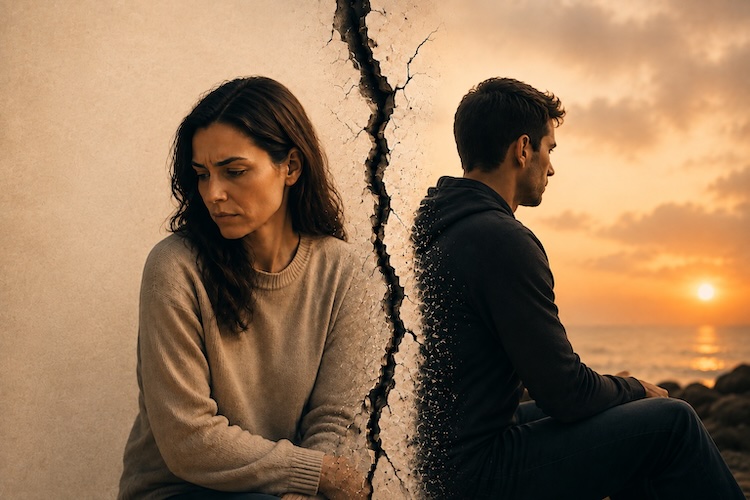
There are some forms of loss that extend beyond the relationship itself.
Sometimes the deepest pain isn’t simply that someone has left.
It’s the feeling that the relationship, and everything it meant, now seems to exist only in your own memory.
Author’s note: The term relational erasure is not a recognised psychological diagnosis or established psychological construct. I use it here as a descriptive way of exploring an experience that I believe many people recognise but for which there is no widely used psychological label.
It describes the feeling that a relationship which profoundly shaped your life is now being treated as though it carries little continuing significance.
Not only has the relationship ended.
It can feel as though its emotional reality has been erased.
Two people rarely leave a relationship in the same place
One of the most difficult aspects of separation is that two people can leave the same relationship with entirely different emotional experiences.
One person may have spent months gradually accepting that the relationship was coming to an end.
The other may have remained fully invested until the day the separation occurred.
Although both people shared the same history, they are no longer living within the same psychological reality.
For the person left behind, it can feel impossible to understand how something that occupied so much emotional space can appear to have become so psychologically distant for the other person.
More than grief
Grief is the natural response to losing someone important.
Relational erasure feels different.
It carries the additional experience that the relationship itself no longer appears to occupy the same place in the other person’s emotional world.
Perhaps they speak about the relationship as though it belongs to another lifetime.
Perhaps they quickly build a new life that appears disconnected from the one you shared.
Perhaps family or friends expect everyone to simply move on.
The pain isn’t necessarily that people are moving forward.
It’s that the relationship itself can begin to feel psychologically invisible.
Why this feels so unsettling
Human beings don’t simply form relationships.
We build identities around them.
Long-term relationships shape our routines, future plans, family traditions, friendships and sense of belonging.
When a relationship ends, we don’t just lose another person.
We often lose the shared story that gave part of our life its meaning.
If it then feels as though that story has disappeared for everyone else as well, the loss can become even harder to process.
It can feel as though an important chapter of your life has been quietly removed from the book while you are still trying to read it.
It doesn’t mean the relationship wasn’t real
One of the traps relational erasure creates is self-doubt.
People sometimes begin asking themselves:
“Did it matter as much as I thought?”
“Was I the only one who experienced it this way?”
The answer is usually more complex.
Relationships are experienced differently by different people.
Two people can genuinely love one another while still carrying very different memories, meanings and emotional timelines after the relationship ends.
The fact that another person has moved forward does not mean your experience of the relationship was somehow false.
It simply means their internal world has followed a different path.
Healing doesn’t require shared memories
One of the hardest parts of recovery is accepting that we may never receive the acknowledgement we hoped for.
We often want reassurance that the relationship mattered.
That our love mattered.
That our grief makes sense.
Sometimes that acknowledgement comes.
Sometimes it doesn’t.
Healing eventually involves recognising that the significance of your relationship does not depend upon another person’s ongoing recognition of it.
Its value isn’t determined by how often it is remembered, spoken about or acknowledged.
Some relationships continue shaping us long after they have ended.
That influence remains real, even if it is no longer shared.
Final thoughts
Perhaps the greatest challenge after unwanted loss is recognising that relationships do not disappear simply because they have ended.
They continue to exist as part of our personal history.
The fact that another person’s emotional world has changed does not erase what the relationship meant to you.
Sometimes healing begins not by asking another person to remember the relationship in the same way we do, but by giving ourselves permission to honour its significance without needing that experience to be shared.