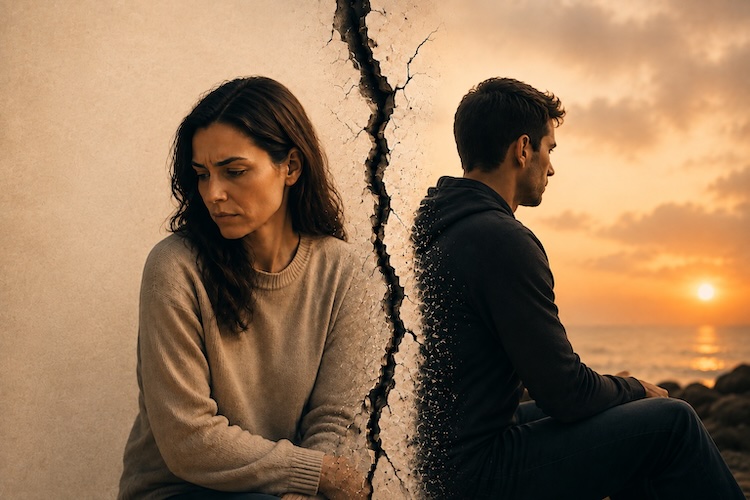



Life has a way of taking things from us, sometimes gradually and sometimes without warning. A relationship ends, a career changes direction, a close friendship drifts apart, a family no longer looks the way it once did, or plans we spent years building quietly disappear.
When this happens, our attention naturally turns towards what has been lost. We notice the absences, remember what used to be and try to understand how life became so different from the version we expected.
Yet beneath every significant loss is another question that often receives less attention:
Have I lost myself too?
It may be one of the most important questions we ever answer.
What does it actually mean to lose yourself?
People often say, “I’ve lost myself,” and most of us understand the feeling even though it can be surprisingly difficult to define.
We do not literally lose our personality. Our memories remain, our history remains, and many of our interests may still be there. What often changes first is something subtler: our trust in our own experience.
We begin second-guessing feelings that once seemed clear. We dismiss our instincts, minimise discomfort or become more concerned with what other people expect of us than with what we genuinely know, value or feel. Over time, our identity can become organised around maintaining circumstances rather than expressing who we are.
Instead of living from the inside out, we gradually begin living from the outside in.
It rarely happens all at once
Losing yourself is seldom the result of one dramatic decision. More often, it happens through the accumulation of countless small ones.
We choose silence because speaking feels too risky. We ignore discomfort because acknowledging it might force us to make a difficult decision. We accept explanations that do not quite fit because the alternative feels too painful to face. We compromise once, then again, and then so often that compromise begins to feel less like flexibility and more like distance from ourselves.
Each individual choice may make sense in the moment. The difficulty is what those choices can become when repeated over time.
Eventually, we may look back and realise that the person making the decisions no longer feels entirely familiar.
Why we let it happen
People do not usually lose themselves because they lack strength. More often, they are trying to protect something deeply meaningful.
A relationship. A family. A sense of belonging. Peace. Hope.
These are not foolish things to value. They are profoundly human. The difficulty is that our efforts to preserve one important part of life can sometimes come at the cost of another.
We can become so focused on holding everything together that we gradually stop asking whether the way we are living still feels aligned with who we are. We may succeed in preserving the relationship, the family structure or the appearance of stability while quietly losing confidence in our own judgement and emotional reality.
That is where self-betrayal can begin.
The relationship beneath every other relationship
We spend a great deal of our lives thinking about relationships with other people: partners, parents, children, friends and colleagues.
Yet every one of those relationships rests on another that receives surprisingly little attention: the relationship we have with ourselves.
Do we trust our own judgement? Can we acknowledge our emotions without immediately dismissing them? Are we living in a way that feels consistent with our values? Can we recognise when something is hurting us without needing someone else to confirm that it is?
When this internal relationship is strong, it provides a kind of stability even when life is uncertain. We may still be grieving, frightened or confused, but we remain connected to something within ourselves that feels dependable.
When that relationship weakens, we often begin searching for certainty outside ourselves. We need reassurance, agreement or permission before trusting what we already know.
Healing is not always about getting the old life back
After loss, it is natural to want life to return to how it was. We long for familiarity, certainty and the future we imagined.
Sometimes parts of that life can be rebuilt. Often they cannot.
This is where healing can begin to look different from restoration.
Instead of asking only, “How do I get back what I’ve lost?” another question becomes possible:
“Who do I want to be now?”
That shift matters because it moves attention away from circumstances that may be outside our control and towards the kind of person we want to remain within them.
We may not be able to recover the relationship, restore the old family structure or return to the future we once expected. But we can still decide whether we want to live honestly, whether we trust our own perceptions, what values we want to protect and what we are no longer willing to abandon in order to keep something else intact.
Loss can clarify what should not be lost
Significant loss often exposes how much of our identity had become attached to particular people, roles or circumstances.
That can be painful. It can also reveal something important.
We begin to see the difference between the life around us and the person living inside it.
A relationship can end without ending our capacity to love. A family structure can change without erasing our role as a parent. A career can disappear without removing our values, competence or history. A future can collapse without eliminating our ability to build another one.
There is grief in recognising that life will not look the way we expected.
There can also be strength in recognising that we are still here.
The self is worth protecting
Life offers no guarantees. Every relationship carries uncertainty, every stage of life changes eventually, and loss is part of being human.
But there is something worth protecting through all of it: our relationship with ourselves.
The ability to trust our own judgement. To remain connected to our values. To take our emotions seriously without allowing them to dictate every decision. To recognise ourselves in the choices we make.
This does not mean becoming rigid or refusing compromise. Healthy relationships require flexibility, generosity and the willingness to be influenced by others.
It means making sure that compromise does not quietly become self-erasure.
Healing is not the absence of loss. It is the gradual return of enough internal stability that what has been lost no longer determines who we are.
And if, after everything life has taken, we can still honestly say,
“Whatever else I lose, I haven’t lost myself,”
then perhaps we have preserved the part of us from which every new beginning becomes possible.