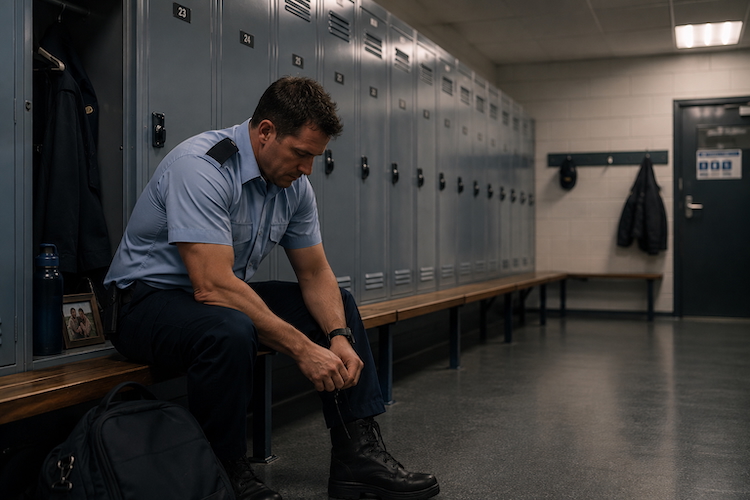
For first responders, being good at the job often requires learning ways of functioning that would be unusual in ordinary life. You learn to notice what other people miss, make decisions quickly, stay composed while others are distressed, and put your own emotional response aside because something more immediate needs your attention.
These are not necessarily signs of psychological difficulty. In the right environment, they are skills. The problem is not that you have learned them; the problem begins when those responses become harder to switch off once the work context has ended.
The nervous system learns the job too
First responder work does not only shape what you think about. It can also shape what your nervous system comes to expect. Repeated exposure to urgency, unpredictability, risk and responsibility trains attention toward what might matter most, and over time certain responses can become automatic.
You may notice exits without deciding to, scan people quickly, detect tension in a room before anyone else seems aware of it, or become highly sensitive to inefficiency, indecision or changes in tone. The same thing can happen emotionally. If your work repeatedly requires you to stay calm while somebody else is distressed, frightened, aggressive or seriously injured, emotional containment becomes practised too.
Often there is no opportunity to fully process what has happened in the moment. There is another task, another person, another decision. The nervous system adapts to that environment because adaptation helps you function, but it does not always instantly recognise when the environment has changed.
The shift can finish while part of you remains on duty.
The problem isn’t vigilance. It’s flexibility.
Vigilance is often discussed as though vigilance itself is pathological, but for first responders that can be misleading. If your work involves unpredictable people, emergencies, violence, accidents or responsibility for other people’s safety, increased attention to potential threat may be entirely appropriate.
The more useful question is whether you can stop doing it when you no longer need to. Can your attention widen again? Can your body settle? Can an unexpected noise simply be an unexpected noise? Can somebody else’s frustration feel like a normal human interaction rather than another problem requiring management? Can you tolerate not knowing exactly what is happening around you?
Psychological flexibility is partly the ability to use a response when it is useful and release it when the situation changes. A work adaptation becomes costly when that flexibility starts disappearing.
The transition home can be harder than it looks
One of the least discussed parts of first responder work is the transition between two very different environments. You may spend a shift dealing with conflict, injury, responsibility, urgency or human behaviour at its worst, and then drive home. Twenty minutes later, somebody wants to talk about the washing machine, a child is upset because their sibling took something, or your partner wants to tell you about a difficult interaction at work.
These concerns are not unimportant. But your nervous system may have spent hours calibrated to a very different level of consequence, and that creates a mismatch. You may understand intellectually that the person in front of you deserves your attention while simultaneously experiencing their needs as irritating, trivial or overwhelming.
This can produce impatience, withdrawal or emotional distance without the person fully understanding why. It is not necessarily that they do not care. They may simply not have transitioned yet.
Emotional control isn’t emotional resolution
First responder work often rewards the ability to remain composed. At a serious incident, your feelings may have to wait, and that capacity can be enormously valuable. But putting an emotional response aside is not the same as resolving it.
Something can be successfully contained without having disappeared. Sometimes unresolved material returns in obvious ways, such as intrusive memories, nightmares, anxiety or physiological arousal. More often, though, the signs can be subtler. You may replay a decision while driving, feel flat rather than distressed, become unusually irritated by small things, want to be alone without knowing exactly why, or notice that it takes longer than it used to before you feel like yourself again.
The accumulation matters too. Psychological strain does not always come from one extraordinary incident. Years of exposure, responsibility, interrupted sleep, organisational pressure and repeated emotional containment can accumulate even when no single event feels like the defining problem.
Where is the job being paid for?
One of the most useful questions in occupational psychology is not simply:
Am I still functioning at work?
First responders can remain highly functional professionally while the cost appears somewhere else.
A more revealing question can be:
Where is the job being paid for?
Perhaps you are still performing well, but need several hours alone afterwards. Your patience at home may have shortened, your sleep may be deteriorating, or your days off may increasingly be spent recovering rather than living. You might find yourself relying more heavily on alcohol, food, gaming, scrolling or constant stimulation to change how you feel, while hobbies, friendships and relationships that once restored you begin to feel like effort.
None of these things alone means that somebody has a psychological disorder. But together they can show that work is being sustained partly because life outside work is absorbing the cost. That distinction matters.
Decompression is not the same as withdrawal
Many first responders need some time after work before they are ready to engage fully with other people, and that can be healthy. A period of quiet, exercise, driving, showering, changing clothes, walking or simply having twenty minutes without conversation can help the nervous system shift state.
The important distinction is between decompression and withdrawal. Decompression helps you reset so you can return to the rest of your life. Withdrawal starts to become a problem when being alone is no longer helping you settle, but instead becomes the main way you avoid ordinary emotional demands.
Does this time help me return to people, or help me avoid them?
If decompression restores connection, it is doing something useful. If it increasingly becomes isolation, detachment or avoidance, that may be worth paying attention to.
Sometimes the adaptation feels like personality
When somebody has worked in policing, paramedicine, fire and rescue or another emergency role for years, occupational adaptations may stop feeling like adaptations and start to feel like personality.
You might think of yourself as simply observant, emotionally controlled, someone who likes knowing what is going on, or someone who needs space after work. Any of those descriptions may be completely accurate, but they can also describe ways of functioning that have been reinforced thousands of times through work.
That creates a useful question:
Is this simply who I am, or is this something I have become exceptionally good at doing?
Then an even more important one:
Can I choose when I do it?
The issue is not whether you are vigilant, emotionally controlled, decisive or self-contained. The issue is whether those responses remain available to you as choices rather than becoming the only way you know how to operate.
Recovery is more than not being at work
Time away from work and recovery are not necessarily the same thing. You can spend six hours on the couch while remaining physiologically activated, distract yourself successfully without your nervous system actually settling, or drink enough to feel relaxed without your system relearning how to come down naturally.
Recovery involves some degree of transition. Different people achieve this differently: exercise works for some, others need quiet, and some benefit from talking while others need a period of decompression first. Music, showering, walking, changing clothes, eating, spending time outside or following a predictable routine can all become useful transition cues.
The specific activity matters less than what it communicates to the system.
You do not have to do that job right now.
The people around you may notice before you do
Changes in ourselves can be difficult to detect when they happen gradually. Someone who has become increasingly vigilant over several years may simply experience vigilance as normal, while someone who has slowly become more emotionally contained may think they are simply becoming tougher.
Partners and family sometimes have a different vantage point. They may notice that you are harder to reach after work, react more strongly to noise, seem less patient, appear physically present but mentally somewhere else, or have become less interested in things that once mattered to you.
This does not mean every observation from somebody close to you is correct, but repeated feedback is information.
Instead of asking only, Do I think I’m coping?, it can be useful to ask:
What is it like to live with me after I’ve been at work?
That can be an uncomfortable question, but it can also be a very informative one.
You don’t have to wait until you’re unwell
There is a tendency in first responder culture to imagine psychological support as something needed only after a person has stopped coping. That creates an unnecessarily high threshold.
You do not need to be unable to work, have a diagnosis, identify one clearly traumatic incident, or prove that things are bad enough. Sometimes the reason to pay attention is much simpler:
The job is taking up more space in the rest of your life than you want it to.
Recognising that early creates more options. The aim is not to eliminate the adaptations that make you effective at work, but to preserve your ability to use them where they belong without requiring the rest of your life to operate by the same rules.
Is work still staying at work?
It can be difficult to judge occupational spillover from a single question. The more useful picture comes from looking across several areas: how easily you switch off, whether your body remains on alert, what you continue carrying emotionally, what happens in your relationships and how effectively you recover.
The First Responder Check-In below is a private guided reflection designed to help you look at those patterns. It is not a diagnostic test and it does not assume that first responder behaviours are pathological.
It asks a more practical question:
Are the responses that help you do the job still serving you when the job is over?
Is Work Still Staying at Work?
First responder work can require vigilance, emotional control, rapid decision-making and the ability to keep functioning under pressure. Those responses can be useful on shift. This reflection looks at whether some of them are continuing when the work context has ended.
What stands out
What this may mean
First responder work can make some of these responses normal and useful in the right environment. The issue is not whether you have them, but whether they are becoming harder to switch off, narrowing your life, or creating costs outside work.
If you are concerned about your immediate safety or someone else's, call 000. In Australia, Lifeline is available on 13 11 14.