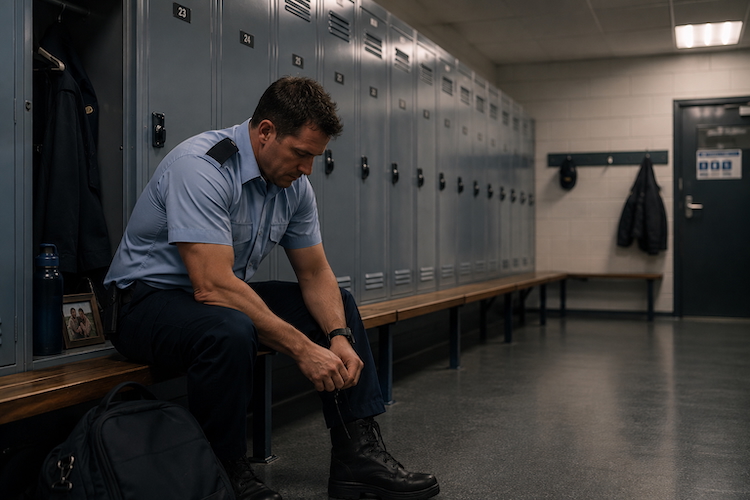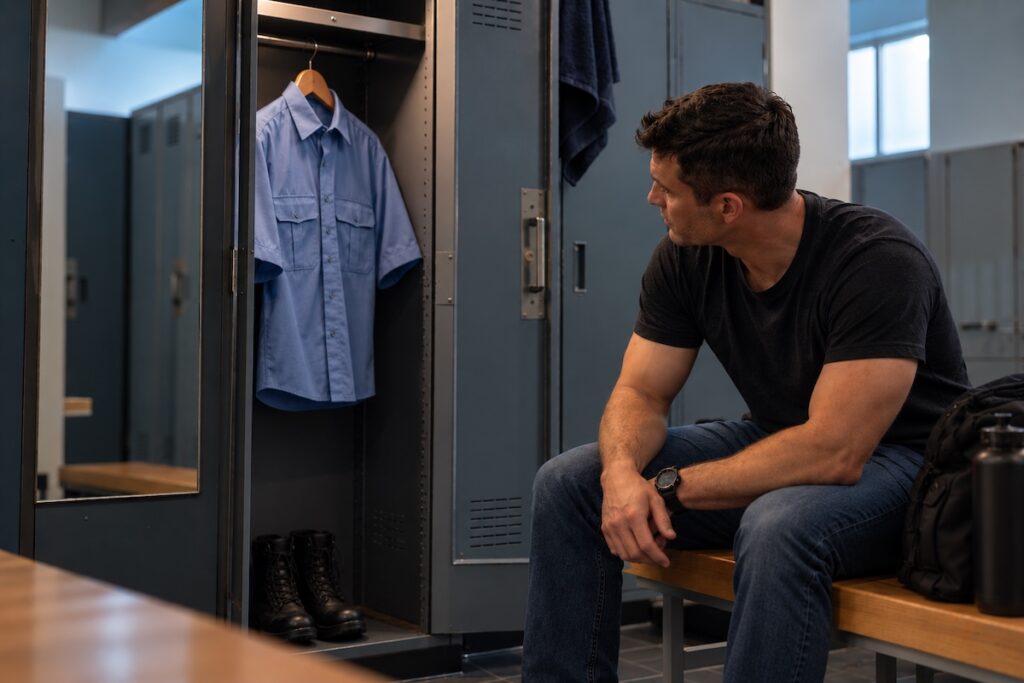
Why confidence can feel different when the role, objective and next step are clear.
A police officer can walk towards an agitated stranger, take control of a difficult situation, ask direct questions and communicate with authority, then feel strangely uncomfortable making conversation at a social event later that week.
For some officers, the contrast can be difficult to understand. At work, they may describe themselves as confident, decisive and comfortable talking to almost anyone. Outside work, they can become quieter, more self-conscious or uncertain about what to say. Someone who routinely manages confrontation may experience social anxiety at a barbecue. Someone accustomed to making decisions under pressure may feel uncomfortable walking into a room where they do not know many people.
It is tempting to explain the difference by saying that the uniform gives them confidence.
There is another possibility.
The capability exists in both situations. What changes are the conditions for accessing it.
Understanding those conditions can tell us something useful about confidence itself.
The uniform comes with a role
When a police officer approaches someone while working, there is usually a reason for the interaction. Something has happened. Information is needed. A problem needs to be understood. Someone may require assistance, direction, reassurance or containment.
The officer does not usually have to wonder whether they have a legitimate reason to approach. Their role has already answered that question. They know why they are there, what they are trying to establish and, at least broadly, what needs to happen next.
Compare that with walking into a social event where you know almost nobody. There may be no obvious person to approach and no clear reason to begin talking. You have to decide what to say, whether the other person wants to talk, how long the conversation should continue and what to do when it pauses.
For someone prone to social anxiety, that ambiguity creates room for self-consciousness:
Do I look awkward? What should I say next? Do they actually want to talk to me? Was that a stupid thing to say?
At work, many of those questions become less important because something else has taken priority.
There is a job to do.
Confidence or less self-consciousness?
This raises an interesting question. When an officer says they are more confident in uniform, have they actually gained confidence?
Perhaps. Wearing the uniform can carry considerable psychological meaning. It represents training, experience, authority and a professional identity that may have developed over many years.
But something else may also be happening.
The work environment removes some of the conditions that normally produce self-consciousness.
Social anxiety often turns attention inward. A person begins monitoring their voice, facial expression, posture, choice of words and the reactions of other people. Instead of simply participating in an interaction, part of their attention is watching themselves participate in it.
Police work can create almost the opposite attentional environment.
An officer arriving at an incident has things to notice. What has happened? Who is involved? Is anyone at risk? What information is missing? What needs to happen next?
Attention has somewhere useful to go.
The difference may therefore be partly about confidence, but it can also be about reduced ambiguity and reduced self-monitoring.
A useful question becomes:
What does being at work give you, and what does it take away?
It may give structure, purpose, legitimacy, a defined role and a next step. At the same time, it may take away some of the ambiguity, self-consciousness and pressure to make a good impression that can make ordinary social situations difficult.
From self-evaluation to task orientation
There is another important difference between professional and social interactions: how success is measured.
Imagine an officer interviewing someone about an incident. The objective might be to establish what happened, obtain relevant information and determine what needs to occur next.
The person being interviewed does not necessarily need to like the officer.
In fact, someone can dislike the officer considerably while the officer still performs the interaction extremely well.
Now compare that with an anxious person entering a social situation. The implicit objective can easily become:
Make a good impression.
Or:
Make sure they like me.
That is a remarkably difficult task because it requires trying to control something that exists inside another person’s mind.
It also encourages monitoring. Are they interested? Did that joke work? Why did they look away? Am I talking too much?
An operational objective is different. It gives attention somewhere external to go.
Instead of:
How am I coming across?
the officer can think:
What needs to happen here?
That shift from self-evaluation to task orientation may explain why someone can feel relatively comfortable in an objectively difficult police interaction while becoming anxious in a socially harmless one.
The dangerous situation may actually contain less interpersonal ambiguity.
Clear processes reduce uncertainty
Police work itself contains enormous uncertainty. Officers routinely attend situations without knowing exactly what they will encounter.
But within that uncertainty sits considerable structure.
There are procedures, legislation, training, operational expectations, radio communication and familiar ways of gathering information. Experience gradually creates patterns. Even when an officer has never encountered exactly the same situation before, much of what they need to do is recognisable.
An experienced officer may arrive with a basic internal sequence:
Assess what is happening. Establish immediate risk. Speak to the people involved. Gather information. Decide what needs to happen next.
That structure matters psychologically.
Uncertainty becomes particularly difficult when we do not know what we are supposed to do with it. A framework for responding can make an unpredictable situation more manageable even when it cannot make the outcome predictable.
Ordinary social interactions often provide much less structure. There is no procedure for joining a group of strangers at a wedding or making conversation with another parent at a children’s event. The objective may simply be socialise, while the criteria for doing it successfully remain vague.
Someone who functions exceptionally well within structure can therefore feel surprisingly uncertain when the structure disappears.
The uniform changes the other person too
Putting on a police uniform does not only change how an officer experiences themselves. It changes how other people respond to them.
The uniform immediately communicates something about who the person is and why they might be approaching. Strangers may answer questions they would find unusual coming from another member of the public. The officer does not need to establish their role from scratch because much of it is already socially understood.
In ordinary life, that information disappears.
At a social event, nobody necessarily knows who you are, what you are like or why you have approached them. Both people have to establish the interaction together.
This does not mean confidence in uniform is artificial. It means confidence is partly contextual.
Most of us find particular versions of ourselves easier to access in some environments than others. We learn the expectations of a role, become familiar with its rules and accumulate evidence that we can function effectively within it.
For an officer who has repeated that process thousands of times, the difference between environments can become particularly pronounced.
“At work, I can talk to anyone”
This is where the contrast becomes therapeutically useful.
An officer might say:
“At work, I can talk to anyone. I don’t know why I’m like this outside work.”
It would be easy to focus on the second sentence.
Perhaps the more useful starting point is the first.
You can talk to anyone.
That capacity has already been demonstrated.
The question is not necessarily Why can’t you talk to people?
A more useful question might be:
What is present at work that allows you to access something you find harder to access elsewhere?
Perhaps there is a clear objective. Perhaps attention is externally focused. Perhaps the professional role removes uncertainty about whether they belong in the interaction. Perhaps there is less pressure to be liked. Perhaps years of repetition have made approaching unfamiliar people ordinary.
Once those differences are identified, the apparent contradiction begins to make sense.
There may not be one confident person at work and an entirely different anxious person at home.
There may be one person with the same underlying capabilities operating under very different psychological conditions.
What if the confidence was already there?
This creates a different way of thinking about what the uniform provides.
Certainly, putting it on may activate a professional identity associated with competence, responsibility and authority. But the confidence may also arise from everything surrounding it: role clarity, purpose, repetition, structure and externally directed attention.
Sometimes the uniform doesn’t give you confidence. It gives your confidence somewhere to stand.
That distinction matters.
If confidence belongs entirely to the uniform, then taking the uniform off means losing it.
But if the uniform helps create conditions under which existing capabilities become easier to access, we can begin asking how some of those conditions might be recreated elsewhere.
The therapeutic task changes from How do we manufacture confidence you don’t have? to What helps the confidence you already demonstrate become accessible here too?
Borrowing structure from the uniformed world
The goal is not to turn ordinary life into an operational exercise. Social connection needs spontaneity, vulnerability and room for interactions to develop without being controlled.
But someone who benefits from structure can borrow a little of it.
Instead of walking into a barbecue thinking I need to be confident, the objective might simply be: I’ll have two conversations before I decide whether I want to leave.
Instead of I need these people to like me, it might become: I’ll find out something interesting about one person.
Instead of repeatedly asking What do they think of me?, attention can move towards: What am I noticing about them? What are they actually saying? What am I curious about?
Role can help too. An officer attending a school event is no longer there as a police officer, but that does not mean they have no role. I’m here as a father. I’m here as a friend. I’m here as a teammate. I’m here because someone invited me and wanted me here.
None of these strategies guarantees that anxiety disappears. Their purpose is different. They provide enough structure for attention to move away from constant self-evaluation and back towards participation.
It is also worth remembering how professional confidence developed. Most officers were not naturally comfortable with every aspect of policing on their first day. Interviewing witnesses, managing confrontation, approaching strangers and making decisions while being watched became easier through training and repetition.
Confidence often follows experience rather than arriving before it.
The same can be true outside work.
When the uniform comes off for longer
This distinction can become particularly important when an officer is injured, takes extended leave, is suspended from duties or eventually retires.
The uniform may disappear at the same time as several other psychological anchors: routine, role clarity, responsibility, camaraderie, competence, purpose and a clear sense of what a useful day looks like.
An officer who functioned confidently for decades may then experience uncertainty that seems inconsistent with who they were at work. They may wonder where that version of themselves went.
Perhaps it did not go anywhere.
Perhaps some of the conditions that reliably brought that person forward are simply no longer there.
Understanding that creates a different task. Rather than trying to recover an identity that belonged exclusively to policing, the person can begin identifying what the role provided and finding other ways of creating structure, purpose, competence and connection outside it.
Taking the person with you
We often divide ourselves into versions: work me, home me, confident me, anxious me, the person in uniform, the person without it.
Different environments genuinely do bring different parts of us forward. But those divisions can obscure something important.
The officer who communicates clearly during a difficult incident, approaches unfamiliar people, tolerates uncertainty, asks uncomfortable questions and remains functional while being evaluated by others has demonstrated real capacities.
The fact that those capacities become harder to access somewhere else does not make them unreal.
The aim is not to recreate policing in ordinary life. It is to understand what the policing environment made easier: knowing why you were there, knowing what mattered, having somewhere useful to direct your attention and trusting that you could work out the next step.
Those conditions helped confidence emerge.
They did not manufacture the person capable of it.
The uniform may provide the structure. The role may provide the objective. The process may provide the next step.
But the person who learned to stand confidently within all of that was still you.