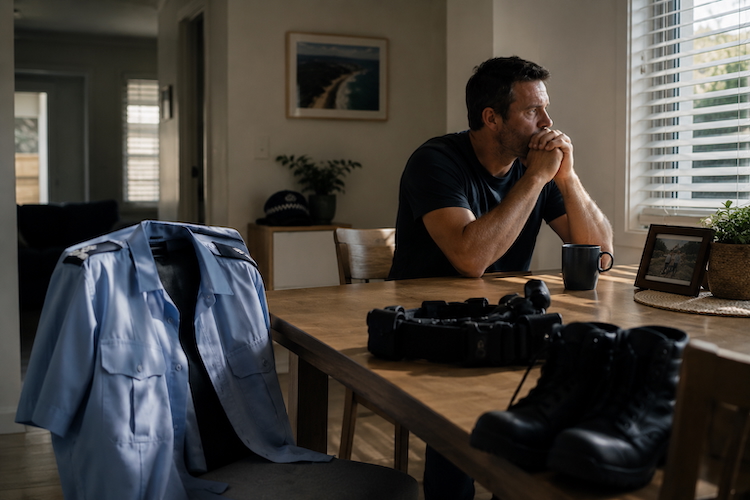
Cynicism is easy to misunderstand in first responder work.
From the outside, it can look like negativity: expecting the worst from people, questioning motives, distrusting organisations or assuming that promises will eventually be broken. To someone who has not worked in these environments, that outlook can seem unnecessarily pessimistic.
But cynicism usually develops for reasons.
Police officers, paramedics, firefighters and other first responders spend years encountering people when something has gone wrong. They see deception, violence, manipulation, neglect, family conflict, institutional failure and the consequences of decisions that other people rarely witness firsthand. They learn that what people say and what people do are not always the same thing, and that apparently ordinary situations can contain information worth questioning.
Some scepticism is therefore not only understandable. It can be professionally valuable.
The difficulty begins when lessons learned in unusually difficult environments start shaping expectations everywhere else.
The question shifts from “Is this person telling me the truth?” to “People lie.”
From “Will this organisation handle this properly?” to “Organisations always protect themselves.”
From “I need more information before I trust this situation” to “Trusting people is how you get caught out.”
At that point, cynicism can stop feeling like a perspective at all.
It starts to feel like realism.
Cynicism often begins as adaptation
Human beings learn from patterns.
If someone repeatedly encounters situations where trusting too quickly creates problems, they become slower to trust. If they see organisations fail people often enough, reassuring language carries less weight. If they spend years hearing explanations that later turn out to be incomplete or untrue, they become more attentive to inconsistencies.
First responder work provides enormous amounts of this kind of learning.
A police officer who accepts every account at face value will struggle. A paramedic who assumes every environment is safe may overlook important risks. A firefighter who expects every incident to unfold exactly according to procedure may be poorly prepared when circumstances change.
Experience teaches caution.
The problem is not becoming harder to fool. It is when caution developed for particular circumstances becomes a general theory about people and the world.
A useful professional lesson can become an increasingly rigid expectation:
People will disappoint you.
Everyone has an angle.
Nothing really changes.
Eventually the system will let you down.
These beliefs are powerful precisely because experience can provide plenty of evidence for them.
The world you see at work is real, but it is not the whole world
One of the most important things to understand about first responder cynicism is that first responders do not encounter a random sample of humanity during their working lives.
Police are disproportionately called when there is offending, intoxication, violence, family conflict, crisis or loss of control. Paramedics encounter people when health deteriorates, substances cause harm, mental health crises occur or families become frightened. Emergency workers generally enter people’s lives because something requires intervention.
Those experiences are real.
But they are also selected.
A police officer attends the family violence incident. They do not attend the thousands of homes that evening where disagreements are resolved without anyone calling police.
A paramedic sees the consequences when someone’s health, judgement or circumstances deteriorate. They do not meet the far larger number of people quietly managing their lives without requiring emergency assistance.
Over thousands of shifts, that difference matters.
First responders may develop a highly accurate understanding of human behaviour within the environments they repeatedly encounter, while gradually developing a less accurate estimate of how common that behaviour is everywhere else.
If much of your professional exposure to people occurs when they are dishonest, aggressive, impaired, frightened or at their worst, it can begin to feel as though the job has simply shown you what people are really like.
In one sense, it has.
It just hasn’t shown you everybody.
Scepticism and cynicism are not the same thing
Scepticism asks for evidence.
Cynicism increasingly assumes the answer before the evidence arrives.
A sceptical officer might think:
That story doesn’t quite add up. I need more information.
A cynical response is different:
Of course it doesn’t add up. People always lie when it suits them.
Both may initially produce caution, questioning and reluctance to trust. Psychologically, however, there is an important difference.
Scepticism remains open to being surprised.
Cynicism becomes increasingly resistant to surprise.
Once an expectation becomes well established, attention naturally begins organising around it. We notice the dishonest person, selfish motive, failed promise or incompetent decision because each one confirms something we already suspect about the world.
Contradictory evidence can become easier to dismiss.
Someone behaves generously.
They probably want something.
A manager follows through on a promise.
Give it time.
Someone takes responsibility without being forced to.
They’re protecting themselves.
Cynicism can therefore become difficult to disconfirm. Evidence supporting it is readily accepted, while evidence challenging it is reinterpreted until it fits.
Why cynicism can feel like maturity
Cynicism can also acquire status within occupational cultures because it often feels sophisticated.
Optimism can begin to look naïve. Trust can look inexperienced. Hope can sound like something people have before they have been around long enough to know how things really work.
The new recruit believes the organisation will support them.
The experienced officer knows it may not.
The younger paramedic is shocked by something they have witnessed.
The veteran has seen versions of it many times before.
Experience genuinely does remove some illusions. People who have worked in emergency services for decades often understand aspects of human behaviour, risk and organisations that others simply have not encountered.
But disillusionment and accuracy are not always the same thing.
Expecting disappointment can feel realistic partly because disappointment no longer surprises us.
That does not mean disappointment is the only reasonable expectation.
When the organisation teaches cynicism too
Not all first responder cynicism is directed towards the public.
Sometimes the deeper cynicism develops towards the organisation itself.
Officers may experience investigations, restructures, staffing shortages, inconsistent leadership or decisions made far from operational reality. They may watch experienced colleagues feel unsupported during difficult periods or see organisational values promoted publicly while experiencing something quite different internally.
Over time, statements such as “the organisation supports its people” can begin to sound hollow.
This can be particularly significant because first responder work is often more than employment. It can become tied to identity, loyalty, competence, purpose and belonging.
When that relationship is damaged, the conclusion can spread beyond a particular event:
They don’t care about people like us.
Management will always protect itself.
Nothing changes.
Sometimes those conclusions emerge from genuine organisational betrayal or repeated experiences of unfairness. It would be simplistic to treat every cynical belief as a cognitive error requiring correction.
The aim is not to persuade someone that an organisation has treated them well when it has not.
The more useful question is whether a justified conclusion about particular experiences has begun deciding the meaning of every future interaction before it occurs.
There is a difference between remembering what happened and assuming that what happened has already determined what will happen next.
Cynicism can become part of belonging
First responder workplaces often develop humour that helps people tolerate difficult material.
Dark humour can reduce tension, create connection and allow teams to talk about experiences that would otherwise be difficult to process. Cynicism can serve a similar social function.
A sarcastic comment about management, the public or human behaviour can communicate something beyond the words themselves:
You’ve seen what I’ve seen.
You know how this really works.
That shared perspective can create belonging.
The difficulty comes when cynicism stops being something a group occasionally uses and becomes something membership seems to require.
Expressions of hope may attract ridicule. Trust can be interpreted as inexperience. Someone who introduces complexity into a cynical conversation can appear naïve rather than thoughtful.
When cynicism becomes part of occupational identity, questioning it can feel less like reconsidering a belief and more like distancing yourself from the people who understand your world.
When the worldview follows you home
The larger cost of cynicism may not appear at work at all.
It appears when the same assumptions become the default setting everywhere else.
A partner offers reassurance and part of the mind searches for the qualification. A friend offers help and the first thought is about what they might want in return. Someone makes an ordinary mistake and it is interpreted as evidence of character rather than human fallibility.
Even good experiences can acquire an expiry date.
Enjoy it while it lasts.
Something will go wrong.
People always disappoint you eventually.
This can gradually change how relationships feel.
Trust becomes harder to offer. Repair becomes harder to believe. Vulnerability feels increasingly unwise. Other people’s motives are scrutinised more closely than their behaviour necessarily warrants.
The person may still care deeply about family and friends. Cynicism does not mean an absence of love.
But continually preparing for disappointment makes it difficult to fully inhabit experiences that require openness.
Cynicism protects against something
This helps explain why simply telling someone to “be more positive” is unlikely to be useful.
Cynicism can serve a protective function.
If you expect people to disappoint you, disappointment hurts less.
If you assume the organisation will fail you, you are less surprised when it does.
If you believe relationships eventually become unreliable, you never have to depend completely on anyone.
Cynicism can reduce vulnerability by ensuring that negative outcomes have already been anticipated.
But protection usually has a cost.
The same stance that reduces the risk of being blindsided can also make loyalty harder to recognise, generosity harder to trust and genuine care harder to receive.
Cynicism often begins as protection from being fooled. The risk is that eventually it becomes protection from being surprised by anything good.
Discernment is different from distrust
The alternative to cynicism is not blind optimism.
First responders do not need to forget what experience has taught them. There is no psychological benefit in becoming gullible, ignoring warning signs or pretending that people and institutions never fail.
A more useful goal is discernment.
Discernment allows experience to inform judgement without automatically determining it.
Some people are dishonest. I don’t yet know whether this person is.
This organisation has handled things badly before. I will pay attention to what it does now.
People can disappoint me. That does not mean everyone will.
This position retains caution while leaving room for evidence.
It allows someone to remain difficult to fool without requiring them to assume that everyone is trying to fool them.
That flexibility is important because the goal is not to replace cynicism with optimism.
It is to become more accurate.
Correcting the sample
One way of loosening cynicism is not to argue with it, but to become curious about what years of occupational exposure may have made less visible.
First responder work provides enormous amounts of evidence for danger, dishonesty, selfishness, incompetence and failure.
What evidence exists in the other direction?
Who consistently follows through?
Who behaves decently when there is nothing obvious to gain?
Which relationships have survived difficult periods?
When has someone taken responsibility when they could have avoided it?
Where have people behaved better than expected?
When has an organisation or colleague actually done what they said they would do?
These questions are not exercises in manufactured positivity. They are attempts to broaden the evidence base.
If someone’s professional life disproportionately exposes them to people when things have gone wrong, intentionally noticing reliability, cooperation and ordinary decency can help correct the sample.
The aim is not to replace cynicism with optimism.
It is to make room for a fuller sample of human behaviour.
When cynicism starts costing more than it protects
Some occupational cynicism may remain relatively harmless. Sarcasm about work, scepticism about people’s accounts or frustration with organisational decisions does not necessarily indicate a psychological problem.
It deserves more attention when the worldview begins shrinking life outside work.
That might mean withdrawing from relationships because trusting people feels pointless, becoming persistently irritated with people who have done little wrong, losing interest in work that once felt meaningful or feeling contempt towards almost everyone outside a very small circle.
For others, the shift appears as hopelessness: the sense that nothing improves, people do not change and effort rarely matters.
At that point, cynicism may be doing more than protecting against disappointment. It may be affecting mood, connection, purpose and the capacity to experience meaning.
Accumulated occupational stress, burnout, trauma exposure and moral injury can all contribute to this shift. When cynicism becomes pervasive or begins affecting relationships and functioning, speaking with a psychologist or another appropriately qualified health professional can be useful.
Not because someone needs to become more positive.
Because they may deserve a broader emotional range than disappointment, suspicion and contempt.
Keeping the experience without letting it become the whole story
First responder work teaches people things about human behaviour that many others never have reason to learn.
Some of those lessons are uncomfortable, and some are true.
People do lie. Institutions do fail. Good intentions do not guarantee good outcomes, and some situations genuinely are dangerous.
The task is not to forget those lessons.
It is to stop them becoming the only lessons that count.
Cynicism becomes limiting when experience stops informing judgement and starts deciding the answer before the evidence arrives.
The goal is not optimism.
It is accuracy.
To remain capable of recognising what is wrong without losing the capacity to notice what is trustworthy, decent or unexpectedly good.
Because the world first responders encounter at work is real.
It just isn’t the whole world.