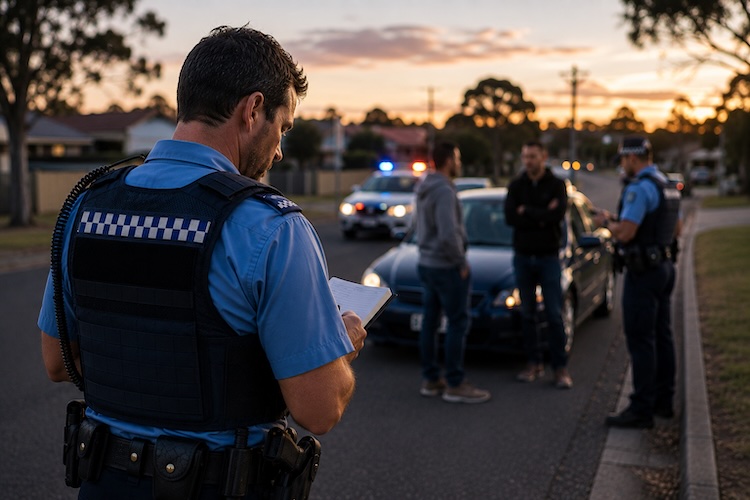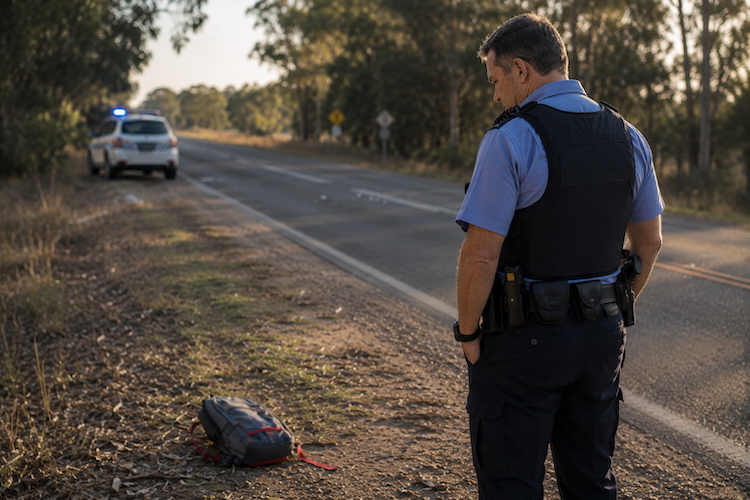
There are parts of police work where the intensity is obvious: a vehicle pursuit, a violent offender, a serious crash, or an urgent call where very little is known and the officers arriving have seconds to work out what is happening. But much of the psychological adaptation to policing occurs somewhere less dramatic. It develops through thousands of ordinary moments in which paying attention matters.
Who is standing near the entrance? Why has that car driven past twice? Where are someone’s hands? Who in the room is becoming agitated? What information is missing? What might happen next?
After enough years, these questions may no longer feel like questions. They become part of how an officer moves through the world, reinforced repeatedly because there are occasions when noticing the small thing early makes an enormous difference.
This can produce an unexpected experience when the demands suddenly disappear. A week of leave arrives, there is nowhere to be, nobody urgently needs anything, and an afternoon stretches ahead without any particular purpose. It should feel relaxing, yet the officer may instead feel restless, wander around looking for something to do, check their phone repeatedly or become disproportionately irritated by having nothing planned. Some find holidays surprisingly difficult. Others discover that after spending weeks complaining about work, they begin looking forward to going back before their leave has finished.
It can seem contradictory. After years of wanting things to settle down, why can it be so uncomfortable when they finally do?
Part of the answer may be that there is a difference between wanting less pressure and being accustomed to calm.
The issue isn’t necessarily that danger has become desirable. It is that a mind trained for years to orient towards uncertainty, consequence and change can find ordinary predictability surprisingly unfamiliar.
The job gives your attention somewhere to go
Police work provides an unusually legitimate purpose for vigilance. Situations can change quickly, people can be unpredictable, information is frequently incomplete, and an apparently routine interaction can become dangerous with little warning. Paying close attention to the environment is therefore not necessarily anxiety or hypervigilance; much of the time, it is simply competent policing.
The job also repeatedly rehearses the ability to move between different levels of activation. A relatively uneventful period can be interrupted by a radio call, after which priorities rearrange themselves almost instantly. Attention narrows, decisions become concrete, and the officer moves from waiting to doing.
Over years, that rhythm becomes familiar. This does not mean officers necessarily enjoy high-pressure situations, nor that their bodies somehow become dependent upon them. It means something more ordinary: human beings adapt to environments they repeatedly inhabit.
If an environment regularly rewards alertness, rapid decision-making, anticipation and readiness for change, a person becomes practiced at those things. The difficulty is that adaptations developed in one environment do not automatically disappear when someone enters another.
At home on a quiet Sunday afternoon, there may be nothing that requires monitoring, anticipating or solving. The external demand has disappeared, but the orientation towards looking for one can remain.
At work, attention has somewhere obvious to go. At home, it can be left searching for something.
Calm and comfortable are not the same thing
We tend to assume that calm environments should automatically produce calm people, but familiarity plays an important role in what feels comfortable.
Consider the rhythm of a long police career: radios, interruptions, uncertainty, competing demands, difficult conversations, constant movement between people and places, and the background possibility that the next call may alter the direction of the entire shift. Even on an uneventful day, there is an expectation that something could happen.
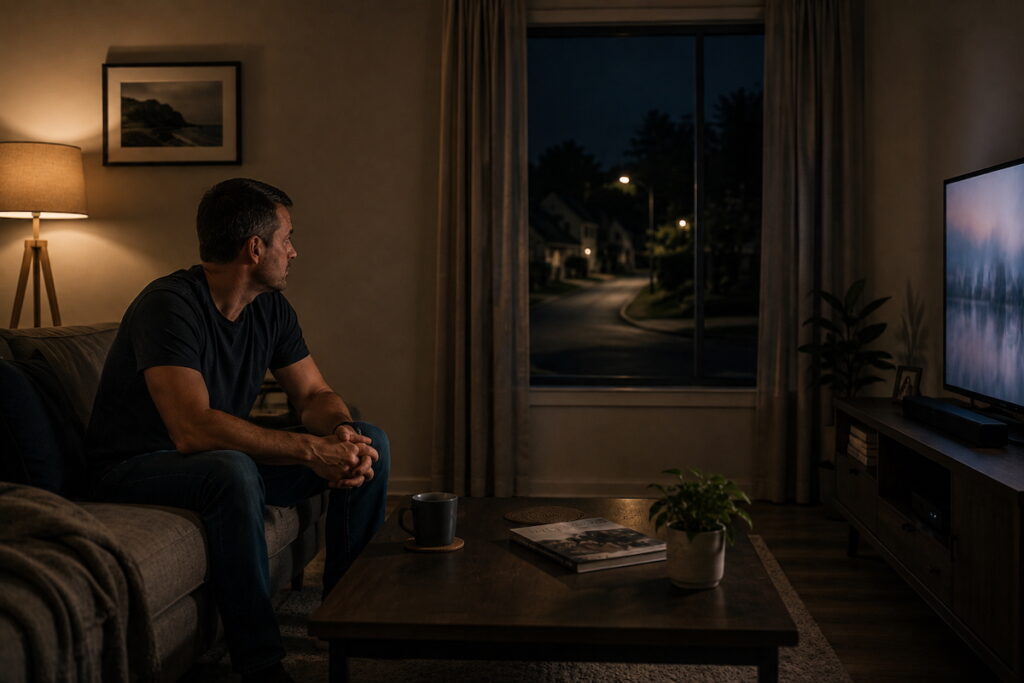
Then consider an ordinary evening at home. Dinner is finished, nobody needs anything, there are no jobs pending and the next few hours contain almost no uncertainty.
For many people, that is exactly what relaxation looks like. For someone whose working life has repeatedly oriented attention towards what might happen next, it can initially feel less like peace than an absence of something familiar.
The experience may be described as boredom, but boredom does not always capture it. There can be restlessness, irritability or a vague sense that something should be happening. The officer might pick up their phone repeatedly without knowing what they are looking for, struggle to watch a film without doing something else, invent tasks, check work messages or find a reason to leave the house.
None of this necessarily means they consciously want excitement, and certainly not that they want danger. It may simply mean that quiet and settled have not yet become synonymous with comfortable.
It is more complicated than being “addicted to adrenaline”
There is a popular explanation for people who work in high-intensity occupations: they become addicted to adrenaline. It is appealing because it turns a complicated adaptation into an easily understood biological story.
It is also often too simplistic.
Police work certainly involves periods of substantial physiological activation, but what an experienced officer becomes accustomed to is much broader than an adrenaline response. The job contains novelty, uncertainty, social intensity, rapid problem-solving, consequence and immediate feedback. There is often a clear relationship between attention and action: something is happening, your role matters, and there is something you can do about it.
Perhaps most importantly, there is purpose.
Even unpredictability can become strangely familiar when someone experiences enough of it. An officer may have no idea what will happen during a shift, but they know that something might, and that expectation gives attention a particular orientation: outward, scanning, anticipating and ready to respond.
Ordinary life often asks for almost the opposite. It asks someone to have dinner without needing to accomplish anything, listen to a partner talk about their day without simultaneously solving a problem, play with their children without watching the clock, read a book, walk without needing to arrive somewhere, or spend an afternoon without turning it into a project.
These things may be objectively easier than police work, but they can require a surprisingly different psychological skill: the ability to remain engaged when nothing urgent is demanding your attention.
Why work can sometimes feel easier than home
This helps explain an apparent contradiction that some officers experience: they can be exhausted by work and yet feel more settled while doing it.
At work, there is a role, a structure and an established set of expectations. There are problems to solve, information to process and decisions to make, and after years of experience the officer may be exceptionally competent in that environment. Even difficult situations can have a familiar logic: assess what is happening, establish priorities, decide what needs to be done, then act.
Home does not always offer the same clarity. Nobody hands you an incident to manage, and a quiet evening with your family may not contain a problem that requires solving. It may simply require you to be there.
That sounds easier until we consider how different it is from the mental position the job has rehearsed thousands of times.
At work, vigilance is rewarded because it helps you detect what matters. At home, the same readiness can begin looking for significance where none is required. A small problem can feel larger simply because problems provide the mind with a familiar organising principle.
The dishwasher has been loaded inefficiently. Something around the house needs repairing. A task that could comfortably wait until tomorrow suddenly feels as though it should be completed tonight. Plans seem unnecessarily vague. Another person’s relaxed approach begins to feel irritating.
Without anyone consciously intending it, ordinary life has provided something that can be assessed, organised or fixed.
This does not mean that every irritable police officer is manufacturing problems because they cannot tolerate calm. Human behaviour and relationships are far too complicated for that explanation. But it can be useful to notice when having a problem to solve feels more comfortable than having nothing that needs solving.
It can also help explain why work occasionally feels simpler than home even when work is objectively more demanding. The problem at work may be serious, but the officer knows what position to occupy in relation to it. Ordinary life asks for a different position: not always assessing, organising or responding, but sometimes simply participating.
Rest is not always the same as settling
Police officers are often told that they need to learn to “switch off,” as though years of occupational adaptation should disappear once the uniform comes off.
The transition is rarely that simple.
There is an important difference between stopping activity and actually settling. Someone can spend an entire evening on the couch while remaining mentally occupied from beginning to end. Scrolling through a phone, gaming, drinking, keeping the television running in the background or filling every spare hour with projects can all reduce the experience of stillness without necessarily creating it.
There is nothing inherently problematic about wanting entertainment or stimulation. The distinction becomes interesting when someone notices that they rarely allow periods in which attention is not being captured by something, and that genuine inactivity quickly produces discomfort.
Distraction gives attention somewhere else to go. Settling gradually reduces the need for it to go anywhere.
For someone who has spent years becoming highly effective at directing attention towards potential problems, that second state may take more adjustment than expected.
There is also a reason the discomfort may become more noticeable precisely when life gets quieter.
Sometimes quiet reveals what activity was covering
During a shift, there may be little opportunity to dwell on a difficult job from the previous week, uncertainty about the future, conflict at home or a growing sense of exhaustion. Radios, colleagues, paperwork, calls and practical decisions continually compete for attention.
Then leave begins and much of that external noise disappears.
Thoughts that were relatively easy to keep in the background now have more room. Memories may become more noticeable. Problems at home can feel more prominent. Someone who assumed they were simply tired may discover that their mood has been lower than they realised.
This can create the impression that being away from work is somehow making them feel worse. Sometimes, however, quiet is not creating the discomfort so much as making existing discomfort easier to hear.
That distinction matters because the natural response may be to restore stimulation as quickly as possible. Work messages get checked, projects appear, the calendar fills, and anything that creates forward movement can feel preferable to remaining with an experience that has no immediate solution.
Busyness is not inherently avoidance. People need purpose, occupation and stimulation, and work can be genuinely meaningful. But if every reduction in external demand creates an immediate need to replace it, it may be worth becoming curious about what happens when the stimulation stops.
Not because stillness is inherently better, but because needing to escape it is different from simply preferring to be busy.
When the rhythm of life changes
Periods of leave can make this adjustment visible, but retirement can magnify it.
During a police career, leave remains temporary. Even several weeks away occurs against the background knowledge that there is a date on which the officer will return, put the uniform back on and re-enter a familiar world. Retirement removes that certainty.
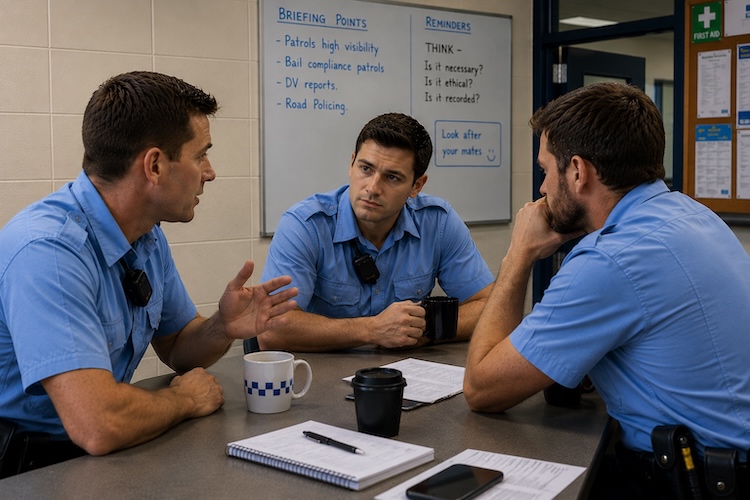
For someone who has spent decades operating in an environment of consequence, unpredictability, frequent interpersonal contact and clear responsibility, the change can be substantial. The roster disappears, the phone becomes quieter, nobody is waiting at briefing, and the next morning may contain very little that absolutely has to happen.
Retirement is rightly discussed in terms of identity, purpose, belonging and the loss of connection with the police community. Alongside those larger changes, however, something simpler may also be occurring: the rhythm of everyday life has changed.
Someone who spent thirty years adapting to one rhythm may now be living inside another. The new rhythm may eventually become deeply enjoyable, but there is no reason to assume it will feel natural immediately.
The question is not whether you enjoy being busy
None of this means police officers should aspire to perfectly serene evenings or deliberately make their lives less interesting. People vary enormously in how much stimulation they enjoy. Some genuinely prefer busy lives filled with exercise, projects, travel, hobbies and social activity, and there is nothing psychologically superior about sitting quietly.
The more revealing question is whether activity still feels like a choice.
What happens when there genuinely is nothing to do? Can you enjoy a quiet afternoon without immediately creating a task, listen to an ordinary conversation without part of your attention searching elsewhere, or take leave without needing every day to contain a project? Can you walk through a shopping centre without automatically assessing everyone around you, sit in a restaurant without repeatedly registering who has entered, or let somebody else manage a situation without feeling compelled to take over?
These are not tests, and noticing these habits does not mean something is wrong. Some may simply be enduring occupational habits that cause no difficulty at all.
The more useful question is whether the person can move between states according to what the situation requires.
That is where flexibility becomes more important than relaxation.
A police officer does not need to lose the ability to scan an environment; there are situations where that ability remains valuable. The question is whether the scanning can stop when it no longer serves a purpose. Decisiveness is useful when a decision needs to be made, but ordinary family life also contains moments that cannot be improved by taking control. Readiness for action is valuable when something is happening, but life contains long stretches in which there is simply nothing to respond to.
Can you access another gear when the environment no longer requires the one policing taught you to use so well?
Learning another gear
There can be an assumption that adjusting after years of policing means returning to the person someone was before the job. For a long-serving officer, that person may be decades away, and trying to recover them may not be particularly useful.
Policing has repeatedly rehearsed certain ways of attending, deciding and responding. Some of the capacities that emerge are enormously valuable: judgement under pressure, attention to subtle changes, decisiveness, composure, reading people and remaining functional when those around you are overwhelmed.
Those capacities do not need to be undone.
What may need developing is another way of functioning alongside them: the capacity for urgency and the capacity for slowness; the ability to scan a genuinely dangerous environment and the ability to stop scanning a safe one; the ability to take control when circumstances require it and tolerate not being in control when they do not.
Perhaps most importantly, there is the ability to remain present when there is nothing to solve.
That is not about becoming less capable. It is about expanding the range of states in which someone can feel comfortable.
After years of policing, the strange feeling that sometimes arrives when nothing is happening does not necessarily mean ordinary life has become boring, that home is unsatisfying, or that someone secretly needs danger to feel alive. It may simply reflect how thoroughly the mind has learned the environment in which it spent so many years.
When vigilance has repeatedly been useful, letting it go can initially feel less natural than maintaining it. When unpredictability has become familiar, predictability can feel oddly empty. And when attention has spent years being rewarded for finding what needs noticing, it can take time to discover that sometimes there really is nothing that needs your attention.
The goal, then, is not to become someone who never feels alert, restless or ready for action. Those capacities have a purpose. It is to become increasingly able to recognise when they are needed and, equally importantly, when they are not.
Because after years of learning that attention should always be ready for what happens next, one of the strangest adjustments can be learning that sometimes nothing is happening, and nothing is required of you.
Calm is not simply the absence of danger. Sometimes it is something that has to become familiar again.