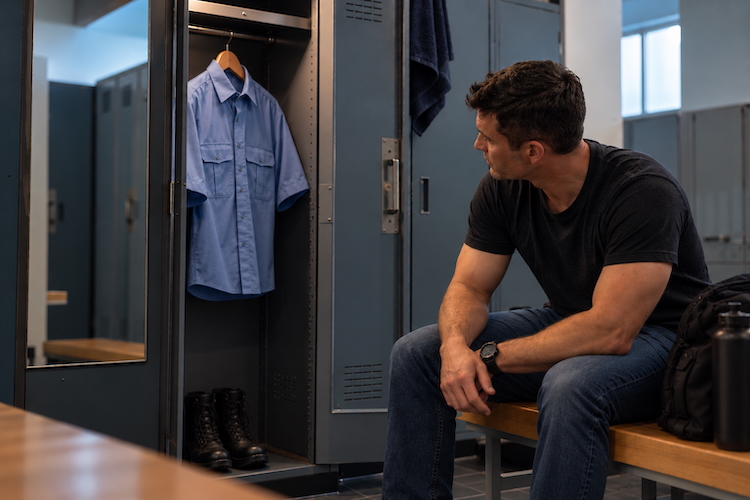



You may still be doing the job well. You turn up, make decisions, deal with difficult situations and go home. Nothing has obviously fallen apart. But somewhere along the way, you may have become shorter-tempered at home, less interested in socialising, more cynical, more alert to what could go wrong, or less willing to talk about what you have seen.
Crowds may feel more irritating than enjoyable. Other people’s problems may seem trivial. You might prefer sitting where you can see the entrance, find yourself automatically watching strangers, or notice that you increasingly want to be left alone when a shift is over.
It can be difficult to identify when these changes happened because there may never have been a single moment when everything changed. Sometimes the psychological impact of first responder work develops less like an injury that happens all at once and more like a gradual adaptation to years of working in circumstances most people encounter rarely, if ever.
Not every psychological impact begins with one traumatic event
When people think about trauma in first responders, they often imagine a particular incident: a fatal crash, suicide, serious assault, child death, violent confrontation or other event that remains vividly connected to later symptoms.
That kind of psychological injury is real, but it is not the only way demanding work can affect someone.
A career in policing, ambulance, fire and rescue, corrections, emergency healthcare or another trauma-exposed occupation may involve hundreds or thousands of encounters with suffering, danger, unpredictability and human behaviour at its worst. Individual incidents may be processed and left behind reasonably well, yet repeated exposure can still influence the way a person responds to threat, emotion, uncertainty and other people.
This does not mean that every first responder will become psychologically unwell. Many people remain resilient across long careers, and exposure itself does not automatically produce disorder. But repeated adaptation to unusual environments can gradually shape a person in ways that are difficult to recognise while those adaptations are still useful.
The first responder may not think, I am struggling.
They may simply think, This is who I am now.
The job trains you to respond differently
Emergency work rewards certain ways of functioning.
When other people are panicking, someone has to remain composed. When a situation is chaotic, somebody needs to assess risk, make decisions and act. When a person is badly injured, there may be no opportunity to stop and process an emotional reaction before dealing with what needs to happen next.
Over time, first responders can become highly skilled at compartmentalising emotion, tolerating distress, scanning for danger, solving problems quickly and remaining functional when circumstances are confronting.
Those capacities are not signs that something has gone wrong. They are often part of what makes someone effective in the role.
The difficulty is that the brain and nervous system do not necessarily divide life neatly into “work responses” and “home responses”. A person who has become very good at suppressing emotion when emotion interferes with the task may find vulnerability uncomfortable in other settings. Someone accustomed to taking control when situations become unpredictable may become frustrated when a partner simply wants them to listen rather than fix the problem. A person whose attention has been repeatedly trained towards danger may continue noticing potential threats when everyone around them appears relaxed.
The adaptation may still be doing exactly what it was designed to do. It is simply appearing in a context where it is no longer particularly useful.
When ordinary problems stop feeling important
Repeated exposure to severe human suffering can also change a person’s internal scale for what constitutes a problem.
After dealing with suicide, violence, fatal accidents, abuse, catastrophic injury or devastated families, ordinary frustrations can begin to feel disproportionately small. Then the first responder goes home and encounters the normal concerns of family life.
A partner is upset about something that happened at work. A child is distressed about a friendship problem. Plans have changed, someone has behaved inconsiderately, or something in the house has broken.
The first responder may understand intellectually that the issue matters to the person in front of them while simultaneously having an internal reaction of, You have no idea what a real problem looks like.
That reaction does not necessarily reflect a lack of care. It may be a consequence of the comparison group against which everyday life is now being measured.
The difficulty is that family members do not experience the comparison. They experience the response.
A partner who repeatedly feels that their concerns are being minimised may eventually stop sharing them. A child who senses that their problems are considered insignificant may become more reluctant to bring those problems home. The first responder may believe they are simply keeping things in perspective while the people closest to them experience increasing emotional distance.
Perspective can be useful. But when extraordinary suffering becomes the standard against which ordinary life is judged, it can become harder to respond to the emotional reality of the people you care about.
Hypervigilance can stop feeling like vigilance
Some occupational adaptations become difficult to recognise precisely because they become familiar.
If you have spent years assessing risk, watching people’s hands, anticipating aggression, approaching unknown situations or entering environments where circumstances can change quickly, increased vigilance may eventually feel less like a stress response and more like being observant.
You may choose particular seats in restaurants without thinking about why. You might notice an agitated person long before anyone else does. You may dislike having people behind you, become unusually irritated by unpredictable behaviour, or find yourself assessing situations that everybody else appears to be enjoying.
The important question is not whether noticing your environment is good or bad. The more useful question is whether the system can stand down when vigilance is not required.
Being able to become highly alert when circumstances demand it is very different from finding it difficult not to be alert.
Over time, the second can become exhausting even when the person no longer consciously experiences themselves as anxious.
Emotional numbing is often more subtle than feeling nothing
Emotional changes can also be misunderstood because people often imagine emotional numbing as a complete absence of feeling.
More commonly, it may appear as a narrowing of emotional range. Things do not affect you as much as they once did. You may not become particularly excited, but you do not become particularly upset either. You still care deeply about your family while feeling less emotionally engaged with them.
Cynicism can develop alongside this. After repeatedly witnessing deception, exploitation, recklessness, cruelty or violence, mistrust may begin to feel less like a change in worldview and more like an accurate understanding of how people really are.
Dark humour can serve an important function as well. It can create psychological distance from experiences that would otherwise be difficult to carry and provide connection with colleagues who understand the context without requiring lengthy explanation.
Neither cynicism nor dark humour is inherently pathological. The more important question is whether the psychological style that helps make the job tolerable has begun becoming the lens through which everything else is viewed.
A person may become increasingly difficult to surprise, but also increasingly difficult to move.
When the people at work feel easier to be around
There is another change that can emerge gradually in long-term first responder work: the people at work may begin to feel easier to relate to than the people at home.
Colleagues understand the shorthand. They know why something that sounds minor to an outsider was significant. They understand the humour, the frustration, the adrenaline and the moments that are difficult to explain without having been there.
There can be enormous relief in not needing to translate your experience.
By contrast, family members may ask questions that feel impossible to answer, respond emotionally to things that no longer shock you, or struggle to understand why you cannot simply switch off after work.
Over time, a quiet belief can emerge:
The people at work understand me. The people at home don’t.
That belief can be understandable, but it can also become dangerous for relationships if it goes unexamined. The workplace becomes the place where the person feels most understood, while home becomes the place where they feel most irritated, scrutinised or disconnected.
The irony is that the relationships at home are often the ones the person most wants to protect.
Connection outside work may therefore require something different from being understood automatically. It may require explanation, patience and the willingness to remain emotionally present with people whose experiences are very different from your own.
The people closest to you may notice first
One of the uncomfortable features of gradual psychological change is that someone else may recognise it before you do.
A partner might say that you seem angrier, quieter or more distant. They may tell you that you are physically present but mentally somewhere else, or that everything appears to irritate you now.
The natural response can be defensiveness, particularly if you are still performing well professionally. From your perspective, you may still be going to work, making good decisions, supporting your family and getting through what needs to be done.
And you may be right.
Psychological change does not necessarily mean psychological collapse.
Someone can remain highly competent while becoming increasingly irritable, detached, exhausted or emotionally restricted. Professional functioning can actually make these changes harder to recognise because it provides strong evidence that you are still coping.
But functioning and wellbeing are not identical.
A person can be very good at their job while becoming less able to enjoy the rest of their life.
Coming home is a psychological transition, not just a physical one
First responders are often trained extensively in how to enter difficult situations. There is usually far less attention given to how to leave them psychologically.
Finishing a shift does not automatically tell the nervous system that the environment has changed. Taking off a uniform, leaving a station, parking an ambulance or driving home may end the workday without immediately ending the patterns of attention and emotional control that were required during it.
For some people, the transition needs to become more deliberate.
That may involve noticing that irritation appearing at home has less to do with the person in front of you than with accumulated activation from the day. It may involve recognising the urge to solve a partner’s problem when what they actually need is to feel understood. It might mean remembering that a child’s problem does not have to be objectively serious in order to be emotionally serious to the child.
It can also involve relearning the value of ordinary life.
Dinner, children’s stories, conversations about someone’s day, walking the dog, gardening, sport or sitting quietly with someone you care about can seem almost absurdly uneventful compared with emergency work.
That is precisely why they matter.
Ordinary life is not the absence of something important happening. For many people, it is where the important things are happening.
You do not need to be falling apart to pay attention
There can be a tendency in high-functioning occupational cultures to wait until distress becomes undeniable before treating it as legitimate.
If you are still turning up, still performing and still getting through the shift, it can be tempting to conclude that nothing is seriously wrong.
But psychological health does not have to be considered only in terms of diagnosis.
It is reasonable to pay attention when sleep has changed, irritability is increasing, alcohol has become more important, relationships are becoming strained, emotional engagement is disappearing, intrusive memories are occurring, or the world increasingly feels unsafe, hostile or exhausting.
It is also worth noticing when the person you are outside work has begun shrinking around the person you need to be at work.
Those changes deserve attention even if you remain competent and effective.
For some people, speaking with a psychologist provides an opportunity to understand these patterns before they become more deeply entrenched. Others may experience persistent or significant symptoms that warrant more comprehensive assessment or treatment.
Seeking support does not require proving that the job has broken you. Sometimes it simply means recognising that years of doing an unusual job can have understandable effects on an ordinary human nervous system.
The aim is not to become who you were before
Long careers change people, and not every change associated with first responder work is negative.
People may become calmer in genuine emergencies, more capable under pressure, clearer about what matters and more appreciative of how fragile life can be. They may develop resilience, humour, perspective and close bonds with colleagues that are difficult to replicate elsewhere.
The aim is not necessarily to remove those adaptations or return to an earlier version of yourself.
The aim is greater flexibility.
It is being able to retain the vigilance, emotional control and decisiveness that may be essential at work while becoming increasingly able to recognise when those responses are no longer required. The same person who can take charge during an emergency can learn to relinquish control at home, and the person who suppresses emotion to get through a difficult job can still make room for emotion once the job is over.
The goal is not to stop the job from changing you.
It is to have some say in which changes you carry home.
“Sometimes the qualities that help you survive the job are the same ones that make it harder to come home from it.”