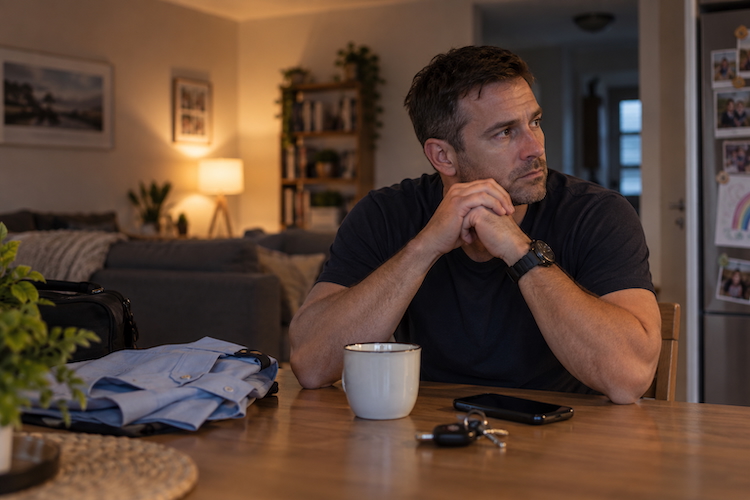



A police officer can end a shift still carrying the weight of it: the noise of radios, the tension of decisions made in seconds, the steady scanning of people and places for risk. Then, not long afterwards, they are standing at a front door where someone is asking about dinner, a child is talking at full volume, and ordinary family life is already in motion.
The shift has finished, but the nervous system may not have caught up yet.
This gap between work and home is easy to underestimate. We tend to imagine the transition as immediate: uniform off, home life on. In reality, the mind and body rarely move that quickly. The patterns that help an officer remain safe and effective at work do not simply disappear at the end of a shift.
Alertness, control, emotional containment, scepticism and rapid decision-making can all be useful in policing, yet become heavy or disruptive when carried unchanged into family life. For many officers, the drive home is therefore not just a commute. It is the space where one version of the self is still winding down while another is expected to begin.
Understanding that space matters, not only for officers, but for the people waiting for them.
Police work trains the brain for a different environment
Even on an ordinary shift, policing requires a particular kind of attention. Officers continually read environments, monitor behaviour, anticipate escalation and make judgements with incomplete information. Most interactions do not become dangerous, but the possibility that something could change means awareness often continues running quietly in the background.
Over time, much of this becomes automatic. An experienced officer may notice someone’s hands, position themselves near an exit, register a change in tone or recognise that something about a situation does not quite fit without consciously working through each step.
This is an occupational adaptation. The brain has become practiced at allocating attention towards information that might matter.
The difficulty is that there is no biological marker announcing that work is over. The system that was useful during the shift does not automatically stand down because the officer has signed off, changed clothes or started driving home.
The body can take longer to finish the shift
After a demanding day, an officer may know intellectually that work is finished while feeling anything but finished. They might be restless, tense, unusually quiet or more easily irritated. Some cannot sit still, while others become emotionally flat and want as little stimulation as possible.
This can be particularly noticeable after a difficult job late in a shift. An officer might spend the final hour dealing with aggression, a distressed family, a serious crash or a situation requiring intense concentration, then be expected to move into family life during a relatively short drive home.
The body does not recalibrate simply because the environment has changed.
That does not necessarily indicate a psychological disorder. Often it reflects the normal lag between the demands someone has just experienced and the time required to recover from them. Problems are more likely when that recovery becomes increasingly difficult or stops occurring altogether.
Two worlds can ask for different versions of the same person
Policing and family life often reward very different ways of functioning.
At work, emotional containment is useful because an officer cannot absorb every distressed person’s emotion and still perform effectively. At home, emotional availability is often more important. At work, clarity, direction and rapid decisions can be essential; at home, a partner describing a difficult day may want understanding rather than a solution.
Scepticism is another example. Questioning information, noticing inconsistencies and considering alternative explanations are useful professional skills. Applied automatically to a partner or child, however, the same approach can feel like mistrust. Similarly, taking control can stabilise a chaotic incident at work while creating unnecessary friction in an ordinary family disagreement.
Neither way of functioning is inherently wrong. The difficulty comes when a mode developed for one environment continues operating automatically in another.
The officer may therefore arrive home behaving in ways that make perfect sense given the previous ten hours, while the people around them experience those same behaviours very differently.
Why the first moments at home can feel so difficult
Consider a familiar scene. An officer finishes a demanding shift and drives home. The drive is quiet, but not necessarily restful. Their mind may still be replaying part of the day, anticipating tomorrow or simply trying to settle after hours of sustained attention.
Then they open the front door.
There is noise, movement and expectation. A child wants attention, someone is asking a question, the television is on and something needs organising. None of this is unreasonable, yet it can suddenly feel like too much.
The officer gives a short response, becomes irritated by something trivial or feels an urgent desire to be left alone. To the family, it may look like withdrawal or bad temper. To the officer, it can feel as though they have moved directly from one set of demands into another without having anywhere to land.
Both sides can then develop explanations that make the situation worse. A partner thinks, “You have energy for everyone at work, but nothing left for us.” The officer thinks, “I can’t even get ten minutes of peace when I get home.”
Often, neither explanation captures what is actually happening. The officer is still adjusting, while family life has understandably continued at its own pace.
The drive home can be a reset rather than an escape
The commute can serve an important psychological function if it is allowed to. It provides a natural buffer in which the officer can begin shifting from one internal state to another.
This does not require forcing themselves to relax or pretending the shift did not affect them. It may simply involve noticing what they are carrying: tension, anger, fatigue, overstimulation, a particular job that keeps returning to mind, or the sense of emptiness that sometimes follows a demanding day.
Different states may require different transitions. Some officers need silence, while others find music helpful. Some benefit from briefly thinking through the shift before deliberately putting it aside; others have already spent enough time thinking and need their attention somewhere completely different. A longer commute might naturally provide enough space, while someone who lives five minutes from the station may need another small ritual to mark the change.
The particular method matters less than its function. The aim is not to arrive home completely calm. It is to arrive already changing direction.
The driveway pause: helpful or avoidance?
Many officers sit in the car for a few minutes before going inside. From the outside, particularly to a partner who has been waiting for them, this can be difficult to understand. They have already had the drive home, so why are they still sitting there?
Sometimes those few minutes are exactly what is needed. The car may be the last quiet environment before the officer enters a house full of conversation, noise and responsibilities. A brief pause can allow the intensity of the shift to drop enough that they enter the house more available than they would have been five minutes earlier.
The same behaviour can, however, become avoidance. Someone might increasingly delay going inside because family interaction itself feels burdensome, or turn a short pause into a much longer period of disengagement.
The distinction is not always clean. A pause can be both regulating and reluctant. What matters is what happens next: does it help the officer enter family life more fully, or does it increasingly become a way of postponing it?
Useful decompression ultimately brings someone back.
The transition is happening to the family too
From the outside, the officer is simply coming home. From the inside, they may still be shifting states.
Partners understandably do not see that internal lag. They see behaviour: silence, irritability, distraction or a request to be left alone. If it happens repeatedly without explanation, it can easily become personal.
A partner may have spent the day working, parenting, managing a household or carrying pressures of their own. They may have been waiting for another adult to arrive or simply looking forward to seeing them. When the officer comes through the door emotionally unavailable, the experience can become, “Home is where you stop trying,” even when that is not the officer’s intention.
Meanwhile, the officer may experience the same moment as being expected to change roles instantaneously without any opportunity to recover.
Neither experience needs to be dismissed. The challenge is that they are occurring at different speeds.
Making the transition visible can reduce that gap. Saying, “I’m glad to be home. I’ve had a big day and need ten minutes to come down, then I’m with you,” communicates something very different from becoming irritable and disappearing without explanation.
The underlying message is: I am not withdrawing from you. I am trying to transition towards you.
Why the first half hour can matter
The first part of the evening often sets the emotional tone for what follows. If an officer enters home still highly activated and the family immediately interprets their behaviour as rejection, a temporary state can quickly become a relationship conflict.
This is why small, predictable routines can be surprisingly useful. One officer may change clothes and shower before properly joining the family. Another may greet everyone first, then take ten quiet minutes. Someone else may walk the dog, make a coffee or spend the final part of the commute without calls or work-related conversation.
There is no ideal ritual, and decompression should not become a rule that requires the entire household to organise itself around the officer. Family members have needs too.
The most useful arrangements tend to be negotiated rather than assumed. Both people know what the transition looks like, how long it roughly lasts and what re-engagement looks like afterwards. This prevents “I need some space” from gradually becoming an undefined period in which the family never knows when the officer will really arrive.
Decompression should help you return, not disappear
Not everything that provides immediate relief supports recovery.
Alcohol may create a rapid sense that the shift is over. Scrolling, gaming or television can occupy attention so effectively that the officer no longer has to notice how they feel. Staying at the station longer than necessary can postpone the demands waiting at home. Even exercise, which can be extremely useful, can become another form of avoidance if every difficult day requires hours away before family life can begin.
The relevant question is not simply, “Does this make me feel better?”
A better question is, “Does this help me return to the rest of my life?”
Good decompression creates a bridge. Avoidance can look similar in the short term, but gradually creates distance.
Sometimes the problem is no longer the transition
For many officers, the pattern is straightforward: work increases activation, some decompression occurs, and the person gradually returns towards their usual state.
The more important question is what happens when that recovery stops occurring.
If irritability lasts throughout the evening, sleep remains consistently poor, family noise feels intolerable, days off no longer feel restorative or the officer spends much of their time at home mentally returning to work, the difficulty may extend beyond an ordinary transition between roles.
At that point, the issue may be accumulation. Chronic occupational stress, burnout, anxiety, trauma exposure, depression or difficulties outside work can all reduce a person’s capacity to recover between demands.
One useful marker is whether the system still returns towards baseline when the pressure is removed. A demanding job will affect how someone feels temporarily. When the temporary state begins becoming the person’s usual state, it deserves more attention.
The transition goes both ways
It is easy to focus only on the journey from police work into family life, but officers do not arrive at the station as blank slates either.
They may have argued with their partner, been awake during the night with a child, received difficult family news, worried about money or spent the morning dealing with an ageing parent. Then they put on a uniform and enter an environment that requires concentration, judgement and emotional control.
The boundary between work and home is therefore permeable in both directions. Stress at home can reduce the capacity available for a demanding shift, just as a difficult shift can reduce what remains available for family life.
This is not a failure of professionalism or family commitment. It is simply recognition that the police officer and the person outside policing are not separate psychological systems.
“Leave work at work” is probably the wrong goal
The advice to leave work at work sounds sensible, but taken literally it asks something impossible.
People cannot decide that an experience will cease affecting them because they have driven away from a station. Some jobs will stay in the mind. Some shifts will change an officer’s mood, and occasionally an experience will need to be talked about or processed long after the uniform has come off.
A more realistic goal is flexible movement between roles.
An officer can recognise that work has affected them without allowing the household to become organised around it. They can ask for space without disappearing emotionally, talk about the job when appropriate while remaining interested in everybody else’s day, and notice when skills that serve them well at work are being applied where they are no longer useful.
The aim is not perfect separation between the two worlds. It is becoming better at crossing the boundary between them.
Taking the uniform off psychologically
The drive home will not solve the psychological demands of policing, and it does not need to. Its value is simpler: it provides a boundary between two environments that ask different things of the same person.
During a shift, an officer may spend hours being vigilant, decisive, emotionally contained and responsible for other people’s problems. Family life often asks for patience, connection, vulnerability, flexibility and the ability to be present when there is no emergency to solve.
Moving between those states takes adjustment. Sometimes it happens naturally; sometimes it helps to make the process deliberate.
The goal is not to become a completely different person the moment the front door opens, nor to erase everything that happened during the shift.
It is to recognise that arriving home physically and arriving home psychologically are not always the same thing.
The drive home provides an opportunity for the two to catch up, so that when the officer walks through the door, they are already on the way back to themselves.